Embark on a vibrant journey into the world of American Sign Language as we explore the fascinating nuances of signing different colors. This guide offers a comprehensive look into the foundational principles, specific techniques, and advanced concepts that bring the spectrum of colors to life through visual communication.
Understanding ASL color signs involves more than just memorizing handshapes; it encompasses the intricate interplay of handshape, location, and movement, all contributing to clear and expressive communication. We will delve into the specifics of signing common colors, explore regional variations, and uncover how these signs are integrated into richer ASL narratives and everyday conversations.
Understanding ASL Color Signs
American Sign Language (ASL) is a rich and visual language where meaning is conveyed through a combination of handshapes, movements, locations, and facial expressions. Understanding the fundamental principles behind signing colors is crucial for clear and accurate communication. These principles ensure that each color sign is distinct and easily recognizable.
The formation of ASL color signs, like all ASL signs, relies on specific linguistic components. These components work together to create a unique visual representation for each color. Mastering these elements allows signers to express a wide spectrum of hues effectively.
Core Principles of ASL Color Signs
The clarity and distinctiveness of ASL color signs are achieved through the precise combination of three primary elements: handshape, location, and movement. Each of these plays a vital role in differentiating one color from another. Understanding how these elements interact is fundamental to learning and accurately producing ASL color signs.
- Handshape: This refers to the specific configuration of the fingers and thumb. For color signs, handshapes are often derived from the initial letter of the English color name or from a shape that visually evokes the color itself. For instance, the sign for “Blue” uses the “B” handshape.
- Location: The place on the body or in the signing space where the sign is performed. This can be the forehead, cheek, chest, or neutral space in front of the signer. The location helps to anchor the sign and prevent confusion with other signs that might share a similar handshape.
- Movement: The path and manner in which the hand moves during the sign. This can include up-and-down, side-to-side, circular, or tapping motions. The movement adds dynamism and further distinguishes one color sign from another.
Common ASL Color Signs and Their Meanings
Below are examples of some commonly used ASL color signs, illustrating the principles discussed. These signs are fundamental for everyday communication and are frequently encountered in various contexts.
| English Color | ASL Sign Description | Meaning |
|---|---|---|
| Red | “R” handshape tapped on the chin. | The color red. |
| Blue | “B” handshape moved down the cheek. | The color blue. |
| Yellow | “Y” handshape wiggled slightly near the temple. | The color yellow. |
| Green | “G” handshape moved back and forth across the chest. | The color green. |
| Orange | “O” handshape touched to the cheek, then slightly opened and closed. | The color orange. |
| Purple | “P” handshape moved in a circular motion near the forehead. | The color purple. |
| Black | Index finger draws a line across the forehead. | The color black. |
| White | Flat hand moves outward from the chest. | The color white. |
Regional Variations in ASL Color Signs
Like any living language, ASL exhibits regional variations and dialects. While the core principles of handshape, location, and movement remain consistent, the specific execution of certain color signs can differ across geographical areas. These variations are natural and do not typically impede comprehension among fluent signers.
For instance, the sign for “Orange” can sometimes be produced with a different handshape or movement in certain regions. Similarly, “Purple” might be signed with a slight variation in its circular motion. It is important for learners to be aware of these potential differences and to observe and learn from native signers in their local communities. Exposure to diverse ASL users will naturally broaden one’s understanding of these dialectal nuances.
The beauty of ASL lies in its visual nature, where even the simplest concepts like colors are brought to life through deliberate and meaningful movements.
Techniques for Signing Specific Colors

Understanding how to effectively sign colors in American Sign Language (ASL) involves more than just knowing the handshape. Each color sign has specific nuances in handshape, orientation, and movement that, when combined with appropriate facial expressions and body language, convey the meaning clearly and vibrantly. This section will guide you through the precise techniques for signing a variety of common colors.Mastering these techniques will enhance your ability to communicate color descriptions fluently and expressively in ASL.
It’s about the visual detail and the overall presentation of the sign, making your communication rich and engaging.
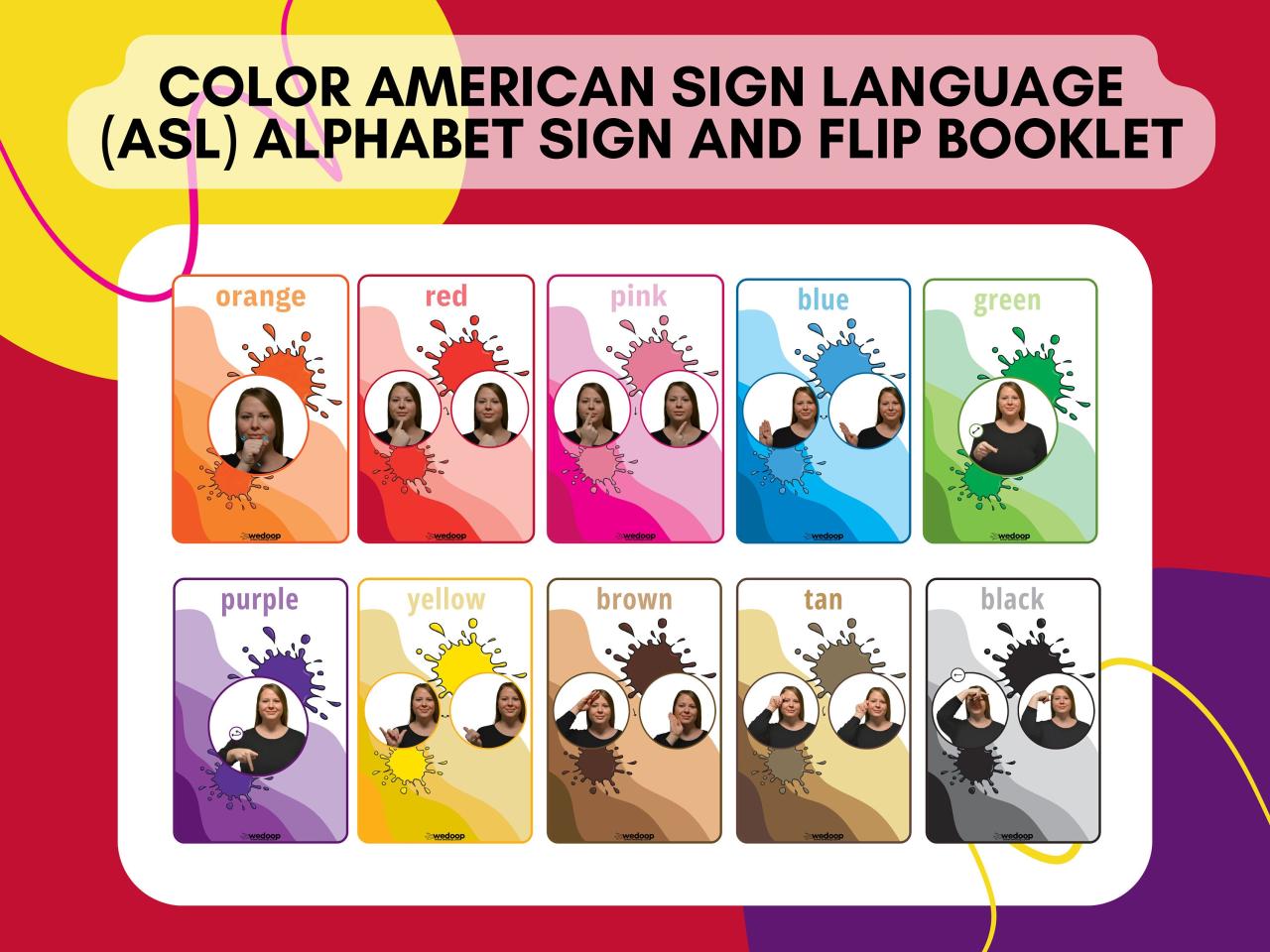
Signing RED
The sign for “RED” is visually evocative of the color itself, often associated with blood or lips. It requires a specific handshape and a distinct movement.The handshape for “RED” is the “F” handshape, where the thumb and index finger touch to form a circle, and the other three fingers are extended. The hand is oriented so the palm faces towards you, or slightly downwards.
The movement involves touching the fingertips of the “F” handshape to your lips, then moving the hand slightly forward. This motion can be repeated or held briefly.
Signing BLUE
The sign for “BLUE” is characterized by its fluid movement and can be enhanced by specific facial expressions that convey the mood or association with the color.The handshape for “BLUE” is the “B” handshape, with all fingers extended and held together, and the thumb tucked across the palm. The palm faces outwards, away from the signer. The movement involves drawing a horizontal line across your chest with your dominant hand.
To add emphasis or a specific nuance, you might use a slightly more relaxed or flowing movement for a calm blue, or a sharper, more deliberate movement for a darker or more intense blue. Facial expressions can range from neutral to conveying a sense of calm, sadness, or coolness, depending on the context.
Signing YELLOW
The method for signing “YELLOW” is distinct and easily recognizable, primarily due to its unique handshape and movement.To sign “YELLOW,” form a “Y” handshape, with the thumb and pinky finger extended, and the middle three fingers curled down. The palm faces outwards. The movement involves shaking the hand slightly from side to side, typically near your temple or in front of your face.
This motion is distinct from other color signs and is a key differentiator.
Signing GREEN
The precise execution of the sign for “GREEN” involves a specific handshape and a deliberate movement that is easy to replicate.For “GREEN,” use the “G” handshape, where the index finger is extended horizontally, and the thumb is held perpendicular to it, forming a “T” shape with the palm facing outwards. The movement involves drawing a horizontal line across your chest with the extended index finger.
There are no significant subtle nuances to this sign; its clarity lies in the distinct handshape and straightforward movement.
Signing ORANGE
Organizing the steps for signing “ORANGE” clearly and concisely makes it easy to learn and remember.To sign “ORANGE,” you will use a cupped handshape, similar to holding a small ball. The palm faces towards you. The movement involves bringing your hand towards your mouth and then moving it outwards, as if peeling an orange or taking a bite. This action is often accompanied by a slight facial expression of tasting or enjoying something.
Signing PURPLE
Creating a sequence of steps for signing “PURPLE” ensures a clear and structured approach to learning this sign.The steps for signing “PURPLE” are as follows:
- Form the “P” handshape, which is a “B” handshape with the index finger bent downwards, touching the thumb.
- Orient the palm to face outwards.
- Move the hand in a circular motion in front of your body. This circular motion is key to differentiating it from other signs.
Signing BLACK
Designing a method for signing “BLACK” that is easily understandable relies on a simple yet effective visual representation.To sign “BLACK,” use your dominant hand to form a flat handshape with fingers together and the thumb extended. Move your index finger across your forehead from one temple to the other. This motion is often interpreted as drawing a line, similar to the color of eyeliner or a dark shadow.
Signing WHITE
Presenting a procedure for signing “WHITE” highlights its straightforward and intuitive nature.The procedure for signing “WHITE” is as follows:
- Use a flat handshape with fingers together.
- Bring your dominant hand to your chest, with the palm facing inwards.
- Move your hand outwards and slightly downwards, as if spreading or radiating something. This motion can be associated with the brightness or purity of white.
Signing PINK
Explaining the process of signing “PINK” involves a slight modification of another color sign, making it easily distinguishable.To sign “PINK,” you begin with the sign for “RED.” After forming the “F” handshape and touching it to your lips, you then modify the movement by adding a slight wiggle or a softer, more delicate motion as you pull your hand away from your lips.
This subtle alteration distinguishes “PINK” from “RED.”
Signing BROWN
Identifying the handshape and movement for signing “BROWN” provides a clear visual cue for this earthy color.The handshape for “BROWN” is a flat hand, with fingers held together. The palm faces towards you. The movement involves tracing the Artikel of the letter “B” in the air in front of you with your index finger. This directly references the spelling of the color.
Advanced ASL Color Concepts
Beyond simply identifying colors, ASL offers a rich tapestry of ways to integrate color vocabulary into expressive communication. This section delves into the nuanced application of color signs, exploring their role in narrative, sentence construction, expressing subtle variations, and understanding their cultural weight within the Deaf community. Mastering these advanced concepts allows for a more vivid and sophisticated ASL experience.
Color Signs in Descriptive ASL Narratives
Color signs are powerful tools for painting vivid pictures in ASL narratives. They move beyond mere identification to contribute to atmosphere, characterization, and setting. For instance, when describing a sunset, a signer might not just sign RED, ORANGE, and YELLOW, but also use facial expressions and body language to convey the intensity and warmth of the colors, making the scene come alive for the viewer.
Similarly, describing a character’s mood can be enhanced by signing colors associated with emotions; for example, a somber mood might be depicted with darker, muted color signs, while joy could be represented with bright, vibrant ones. The strategic placement and modulation of color signs within a narrative can significantly amplify the emotional impact and visual richness of the story being told.
Combining Color Signs with Other ASL Vocabulary
Effectively combining color signs with other ASL vocabulary is crucial for forming coherent and meaningful sentences. This involves understanding ASL’s grammatical structure, which often differs from English. Color signs can function as adjectives, nouns, or even verbs depending on the context. For example, to say “The blue car is fast,” one might sign CAR (with a specific classifier for the vehicle) then BLUE, followed by FAST.
The relationship between the color and the object is established through spatial agreement and non-manual markers. Another example: “I like to wear green shirts.” This could be signed as ME LIKE WEAR SHIRT GREEN. The sequence and the classifier used for “shirt” (e.g., a flat hand representing a garment) help clarify the meaning.
Expressing Shades or Tints of Colors in ASL
ASL provides ways to express subtle variations in color, akin to shades and tints in spoken languages. This is often achieved through modifying the basic color sign. For instance, to indicate a lighter shade of blue, one might sign BLUE with a lighter, more open handshape, or by slightly mouthing the word “light.” Conversely, a darker shade could be signed with a more closed handshape or a deeper facial expression.
Another technique involves incorporating descriptors like “light” or “dark” before or after the color sign, or using specific classifiers that suggest the texture or opacity of the color. For example, a pale yellow might be conveyed by signing YELLOW with a softened handshape and a gentle movement, perhaps combined with the sign LIGHT.
Cultural Significance of Colors in the Deaf Community
Certain colors hold particular cultural significance within the Deaf community, often reflected in their ASL signs. For instance, while BLUE is a standard color sign, it can also be associated with the Deaf pride movement, particularly when used in conjunction with other symbols or during Deaf awareness events. The color YELLOW has sometimes been used in historical contexts related to Deaf education and advocacy.
The understanding of these cultural nuances enriches the interpretation of color signs beyond their literal meaning. It’s important to note that these associations can evolve and may vary within different sub-groups of the Deaf community.
Comparing and Contrasting Similar ASL Color Signs
Some ASL color signs share similar handshapes or movements, requiring careful attention to distinguish them. For example, the signs for YELLOW and ORANGE, while distinct, might both involve a circular motion. The key differences often lie in the specific finger configuration or the precise location of the movement. YELLOW typically uses a “Y” handshape moving in a circle near the forehead, while ORANGE might use a slightly different handshape (often a closed fist with the thumb extended) and a similar circular motion, but with a distinct facial expression.
Similarly, the signs for RED and PINK can be confused. RED often involves a flat hand with the index finger touching the chin, while PINK might use the index finger to trace the Artikel of the lips or cheek, often with a lighter touch. Understanding these subtle distinctions is vital for accurate ASL comprehension.
Visualizing ASL Color Signs

Understanding the visual aspects of ASL signs for colors can greatly enhance your comprehension and execution. These signs are not merely abstract movements; they often incorporate elements that evoke the very essence of the color or concept they represent. By focusing on the handshapes, movements, and facial expressions, you can gain a deeper appreciation for the artistry and logic within ASL.This section delves into the visual characteristics of several key color-related signs, offering a descriptive guide to help you picture and perform them accurately.
We will explore how movement, handshape, and spatial orientation contribute to the meaning of signs like “RAINBOW,” “COLORFUL,” “BRIGHT,” and “DARK.”
RAINBOW
The sign for “RAINBOW” is a beautiful and fluid representation of this natural phenomenon. It typically begins with a closed “F” handshape (thumb and index finger touching, other fingers extended and slightly curved) or a “V” handshape. The signer then traces an arc in front of them, moving from one side to the other, mimicking the curved shape of a rainbow.
The movement is smooth and graceful, often accompanied by a slight up-and-down undulation to suggest the layered colors. Some signers might also incorporate a slight smile or a look of wonder to further enhance the visual.
COLORFUL
The sign for “COLORFUL” is dynamic and engaging, reflecting the vibrancy of multiple hues. It often starts with the non-dominant hand in a flat, open palm position, representing a surface or canvas. The dominant hand, typically in an open “5” handshape (all fingers spread), then moves in a circular or swirling motion above the non-dominant hand. This movement suggests colors being spread or mixed, creating a vibrant and varied effect.
The pace of the movement can vary, with faster motions implying more intense or numerous colors.
BRIGHT
When used in the context of colors, the sign for “BRIGHT” conveys a sense of intensity and luminescence. The sign usually involves an open “5” handshape, with the fingers spread wide. The hand then moves outward from the face or chest, with the fingertips pointing forward, as if emitting light. The movement is sharp and expansive, often accompanied by wide eyes and a bright facial expression to emphasize the radiance.
Imagine the sun’s rays bursting forth – this is the visual energy the sign aims to capture.
DARK
The sign for “DARK” provides a visual contrast to “BRIGHT” and represents the absence or dimness of light. It is typically performed with a closed “F” handshape or a “C” handshape. The hand is brought towards the face, often covering or partially obscuring the eyes, or it moves downwards in a sweeping motion, as if bringing down a shade or curtain.
The movement is generally slower and more deliberate than “BRIGHT,” and the facial expression might be more subdued or serious, conveying the sense of obscurity associated with darkness.A step-by-step visual breakdown of signing “DARK” in ASL:
- Start with your dominant hand in an “F” handshape (thumb touching the side of the index finger, other fingers extended) or a “C” handshape.
- Bring your hand towards your face, either in front of your eyes or to the side of your head.
- Move your hand downwards in a slow, deliberate sweeping motion. This motion can suggest a shadow falling or a curtain being drawn.
- Maintain a neutral or slightly serious facial expression to convey the feeling of dimness or obscurity.
Practical Application of Color Signs
Integrating ASL color signs into everyday communication significantly enhances expressiveness and clarity. This section explores various ways to actively use these signs in practical contexts, from simple questions to descriptive conversations and effective learning strategies. Mastering these applications will make your ASL communication more vibrant and nuanced.
Common Phrases Utilizing Color Signs
Familiarizing yourself with common phrases that incorporate color signs is a fundamental step in practical ASL usage. These phrases cover a range of everyday interactions, making them essential for conversational fluency.
- What is your favorite color?
- I like the blue shirt.
- The car is red.
- Do you have this in green?
- My eyes are brown.
- The sky is gray today.
- She is wearing a yellow dress.
- This flower is purple.
- The banana is ripe (yellow).
- He painted the wall white.
Demonstration Dialogue Using Multiple Color Signs
This dialogue illustrates how color signs can be naturally woven into a conversation, showcasing their utility in describing objects and preferences.Person A: HELLO! HOW ARE YOU?Person B: I AM GOOD, THANK YOU. AND YOU?Person A: I AM GOOD. LOOK AT THIS NEW BOOK I BOUGHT.Person B: WOW, IT IS VERY NICE. WHAT COLOR IS IT?Person A: IT IS A DEEP BLUE.
I LOVE IT.Person B: IT REALLY POPS. MY FAVORITE COLOR IS GREEN, LIKE GRASS.Person A: OH, GREEN IS BEAUTIFUL TOO. MY SISTER JUST BOUGHT A NEW CAR. IT IS BRIGHT RED.Person B: RED IS A VERY BOLD COLOR. MY MOTHER PREFERS ORANGE FOR HER GARDEN FLOWERS.Person A: THAT MAKES SENSE.
ORANGE IS SO CHEERFUL.
Scenario for Practicing Color Identification with ASL Signs
A practical scenario for reinforcing color recognition involves a game of “I Spy” adapted for ASL. This method encourages active recall and application of color signs in a fun and interactive way.Imagine you are in a room with another ASL learner. One person can choose an object in the room and sign “I SPY WITH MY LITTLE EYE SOMETHING [sign for color].” The other person then tries to guess the object by asking questions that involve colors, such as “IS IT THE CHAIR?
IS IT RED?” or by pointing and asking “THAT [pointing to object] IS WHAT COLOR?” This back-and-forth encourages both visual identification and ASL production.
Describing an Object’s Color Using ASL
Describing an object’s color in ASL typically involves first identifying the object and then signing its color. For more specific shades or complex descriptions, you might combine the basic color sign with other signs that denote intensity or nuance.For instance, to describe a “light blue shirt,” you would first sign “SHIRT,” then sign “BLUE,” and then potentially use a facial expression or a modifier sign to indicate “light” or “pale.” Alternatively, you might sign “BLUE” with a lighter, more open handshape or a slightly different movement to convey the shade.
For “dark green,” you would sign “GREEN” with a more closed or intense movement, possibly accompanied by a furrowed brow to indicate depth.
Methods for Learning and Remembering ASL Color Signs Effectively
Effective learning and retention of ASL color signs can be achieved through various strategies that engage different learning styles. Consistent practice and creative application are key to long-term memory.
- Visual Association: Connect each color sign with a real-world object of that color. For example, when learning the sign for RED, think of an apple or a stop sign.
- Repetition and Practice: Regularly practice signing each color, both individually and in phrases. Use flashcards or apps that pair the color name with its ASL sign.
- Contextual Learning: Incorporate color signs into everyday conversations. Point out objects and sign their colors throughout the day.
- Mnemonics: Create personal mnemonics or stories that link a color sign to its meaning. This could involve associating the handshape or movement with something memorable.
- Group Practice: Practice with friends or in an ASL class. Teaching or explaining the signs to others can solidify your own understanding.
- Labeling: Label objects around your home with their corresponding color signs (written or printed).
Last Recap
As we conclude our exploration of How to Sign Different Colors in ASL, we’ve journeyed from the fundamental principles to practical applications, equipping you with the knowledge to express a full spectrum of hues. Mastering these signs not only enhances your ASL vocabulary but also deepens your appreciation for the visual richness and cultural significance of colors within the Deaf community.
Continue practicing, and let your ASL communication be as colorful as the world around you!