How to Properly Structure a Sentence in ASL offers a fascinating exploration into the visual and spatial grammar of American Sign Language. This guide delves into the fundamental differences between English and ASL sentence construction, unveiling the elegant topic-comment structure and the critical role of non-manual markers.
We will journey through the core components of an ASL sentence, understanding how verbs, nouns, adjectives, classifiers, and adverbs work in concert. The intricacies of ASL word order and syntax will be clarified, contrasting them with English patterns and highlighting the significance of spatial agreement and directional verbs. Furthermore, the essential function of non-manual markers, from facial expressions to eye gaze, in conveying questions, emphasis, and emotional tone will be illuminated.
The guide will also equip you with the knowledge to build complex sentences, incorporate conjunctions, express conditionals, and master negation, all while leveraging the unique visual and spatial elements inherent in ASL.
Introduction to ASL Sentence Structure
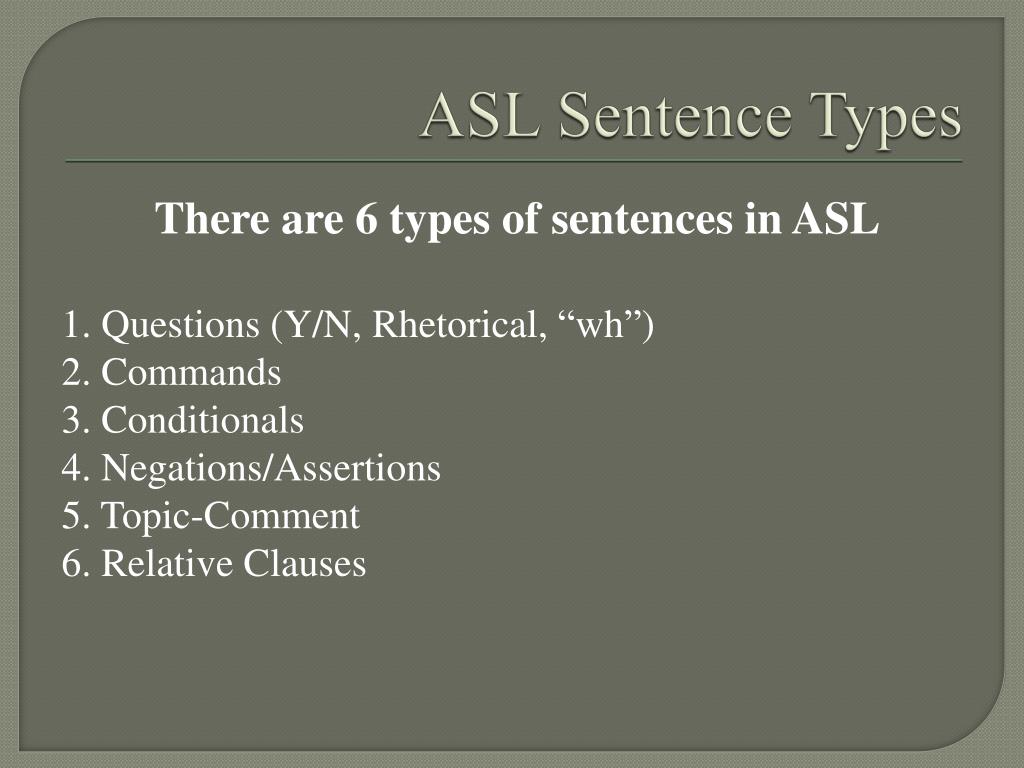
American Sign Language (ASL) possesses a unique and rich grammatical structure that significantly differs from English. Understanding these fundamental differences is crucial for effective communication and accurate interpretation in ASL. ASL is not simply a signed version of English; it is a visual-gestural language with its own syntax, morphology, and semantic principles.One of the most significant distinctions lies in the way information is organized and presented.
While English typically follows a Subject-Verb-Object (SVO) order, ASL often employs a different, more flexible structure that prioritizes the most important information first. This approach allows for a more direct and efficient conveyance of meaning, leveraging the visual nature of the language.
The Concept of Topic-Comment Structure
A cornerstone of ASL grammar is the topic-comment structure. In this framework, the topic, which is the subject or the main point of the sentence, is established first. This is followed by the comment, which provides information or describes the topic. This structure is highly effective in visual languages as it immediately directs the viewer’s attention to the primary focus of the communication.For example, in English, one might say, “The dog is brown.” In ASL, this would typically be structured as DOG BROWN (with the sign for DOG followed by the sign for BROWN).
Here, “DOG” is the topic, and “BROWN” is the comment, describing the dog. This topic-first approach is prevalent across many ASL sentences, making it a fundamental concept to grasp.
The Importance of Non-Manual Markers (NMMs)
Non-manual markers (NMMs) are an integral part of ASL grammar and meaning. These include facial expressions, head movements, body posture, and eye gaze. NMMs are not mere embellishments; they function as grammatical markers, conveying crucial information such as questions, negation, intensity, and the relationship between different parts of a sentence.For instance, raised eyebrows and a forward head tilt often indicate a yes/no question, while a furrowed brow might signal a wh-question (who, what, where, when, why).
The absence or specific type of NMM can completely alter the meaning of a signed utterance. Therefore, observing and understanding NMMs is as vital as understanding the manual signs themselves.
Common ASL Sentence Order
While ASL sentence structure can be flexible, a common and often preferred order is Time-Topic-Comment. This means that temporal information, if present, is typically signed first, followed by the topic, and then the comment. This structure helps to set the context for the rest of the sentence.Consider the sentence “Yesterday, I ate pizza.” In ASL, this might be structured as:
- Yesterday (Time)
- I (Topic)
- EAT PIZZA (Comment)
This order ensures that the listener knows when the action occurred before processing who performed the action and what the action was. Other common orders include Topic-Comment and variations that emphasize specific elements for clarity or stylistic effect. Understanding these common patterns provides a solid foundation for constructing and interpreting ASL sentences.
Core Components of an ASL Sentence
Understanding the fundamental building blocks of an American Sign Language (ASL) sentence is crucial for constructing clear and grammatically sound expressions. Just as English relies on subjects, verbs, and objects, ASL has its own set of core components that work together to convey meaning. These components, when combined effectively, allow for the nuanced and dynamic communication characteristic of ASL.ASL sentence structure, while distinct from English, follows logical patterns.
The primary elements are often verbs, nouns, and adjectives, but their function and placement can differ significantly. Furthermore, ASL employs unique grammatical tools like classifiers and adverbs to enrich descriptions and specify actions, making the language highly visual and descriptive.
Primary Elements: Verbs, Nouns, and Adjectives
Verbs are the action words in ASL, indicating what is happening. Nouns represent people, places, or things. Adjectives describe the qualities or characteristics of nouns. In ASL, these components are not always signed in the same order as in English, and their meaning is often conveyed through a combination of handshapes, movements, and facial expressions.* Verbs: ASL verbs can be static or dynamic.
Static verbs, like THINK or KNOW, often have a consistent location and movement. Dynamic verbs, such as RUN or EAT, typically involve movement that can be modified to indicate the subject, object, and manner of the action. For instance, the verb RUN can be signed differently to show one person running, two people running, or running quickly.
Nouns
Nouns are represented by specific signs. The context and accompanying non-manual markers (facial expressions and body language) often clarify whether a sign refers to a singular or plural noun, or if it’s being used as a subject or object.
Adjectives
Adjectives in ASL are frequently signed after the noun they modify, similar to English. However, the intensity and manner in which an adjective is signed can also convey grammatical information. For example, signing the adjective “BIG” with exaggerated facial expression and a larger movement can emphasize the size.
Classifiers: Representing Objects and Movement
Classifiers are a sophisticated grammatical tool in ASL that allows signers to represent objects and describe their spatial relationships, movements, and actions. They are essentially handshapes that stand for a particular category of object (e.g., a person, a vehicle, a flat surface) and are then manipulated in space to convey information.Classifiers are incredibly versatile and can depict:
- The shape and size of an object.
- The number of objects.
- The location of objects relative to each other.
- The movement of objects (e.g., a car driving, a person walking, a ball rolling).
- The interaction between objects.
For example, the “B” handshape can be used as a classifier for a flat, rigid object like a table or a book. If you want to show a book falling off a table, you would first establish the location of the table using a classifier for a surface, then show the “B” handshape (representing the book) moving from the surface and falling.
Adverbs: Modifying Actions and Descriptions
Adverbs in ASL modify verbs, adjectives, or other adverbs, providing more detail about how, when, where, or to what extent an action is performed or a description is made. Similar to English, adverbs in ASL often convey intensity, frequency, or manner.The role of adverbs in ASL is often integrated into the verb sign itself through non-manual markers or specific modifications of the verb’s movement and facial expression.* Manner: The way a verb is signed can indicate the manner.
For example, signing the verb “WALK” with a slumped posture and slow movement conveys walking slowly or tiredly. Signing it with quick, energetic movements and a bright facial expression shows walking quickly or happily.
Intensity
Adverbs of intensity are often conveyed through the size of the movement, the speed, and the accompanying facial expressions. For instance, signing “LIKE” with a very strong, sweeping motion and an exaggerated smile indicates “really like.”
Frequency
While some adverbs of frequency have specific signs (e.g., OFTEN, SOMETIMES), others can be conveyed through the repetition or modification of a verb sign.Consider the sentence “He ran quickly.” In ASL, this might be signed by establishing the person, signing RUN with rapid hand movements and a determined facial expression, effectively incorporating the adverbial sense of “quickly” into the verb itself.
Understanding ASL Word Order and Syntax

While English often relies heavily on strict word order to convey grammatical meaning, ASL possesses a more flexible yet systematic approach to sentence construction. Understanding these fundamental differences is crucial for constructing clear and comprehensible ASL sentences. ASL utilizes a variety of syntactic structures, with the Topic-Comment structure being particularly prominent, allowing for emphasis and clarity.ASL’s syntax is intricately linked to its visual-gestural modality.
The placement of signs, the use of space, and the movement of the hands and body all contribute to the grammatical structure and meaning of a sentence. This is a significant departure from English, which is primarily an auditory-sequential language.
Typical ASL Sentence Patterns
ASL employs several common sentence patterns, with Subject-Object-Verb (SOV) and Topic-Comment being the most prevalent. Recognizing these patterns helps learners anticipate the flow of information and understand the relationships between different elements in a sentence.The SOV order is frequently observed in ASL, especially when describing actions involving a subject performing an action on an object. However, ASL is not rigidly bound to this order; context and emphasis can lead to variations.
The Topic-Comment structure, on the other hand, allows the signer to establish a topic first, then provide information or commentary about that topic. This structure is highly effective for highlighting specific information.
ASL vs. English Syntax: Key Divergences
The differences between ASL and English syntax are substantial, stemming from their distinct linguistic origins and modalities. English is a linear language where word order is paramount for meaning, while ASL is a spatial language where the use of space and non-manual signals play a vital grammatical role.Key divergences include:
- Verb Agreement: English verbs change form based on the subject and tense. In ASL, many verbs are “directional,” meaning the movement of the verb from one location to another indicates the subject and object.
- Use of Articles and Prepositions: English heavily relies on articles (a, an, the) and prepositions (in, on, at) to convey relationships. ASL often omits these, with spatial relationships and verb directionality serving a similar purpose.
- Topicalization: ASL frequently front-loads information by establishing a topic before commenting on it. While English can topicalize (e.g., “That book, I read it”), it is a more fundamental and pervasive structure in ASL.
- Adjective and Adverb Placement: In English, adjectives typically precede nouns, and adverbs modify verbs or adjectives. In ASL, adjectives and adverbs can be placed differently, often with specific non-manual markers to indicate their function.
The Function of Spatial Agreement in ASL Sentences
Spatial agreement is a cornerstone of ASL grammar, enabling signers to establish and maintain relationships between entities within the signing space. This agreement is achieved through the strategic placement of signs and the movement of the hands, effectively creating a visual representation of the sentence’s participants and their interactions.Spatial agreement functions in several ways:
- Establishing Referents: Specific locations in the signing space are assigned to individuals or objects. These locations then serve as pronouns or placeholders for those referents throughout the discourse.
- Indicating Relationships: The movement of a verb between established locations clearly shows who is performing the action and who is receiving it, akin to subject-object agreement in spoken languages.
- Showing Location and Direction: Signs can be placed in specific locations to indicate where something is or where it is going, adding descriptive detail and context.
- Maintaining Consistency: Once a referent is established in a particular location, subsequent signs referring to that entity should originate from or move to that same location, ensuring clarity and coherence.
How Directional Verbs Contribute to Sentence Structure and Meaning
Directional verbs are a class of verbs in ASL that incorporate the subject and object directly into their movement. The direction and orientation of the verb’s movement convey who is doing what to whom, significantly reducing the need for separate subject and object signs. This contributes immensely to the efficiency and visual richness of ASL sentences.The contribution of directional verbs to sentence structure and meaning is profound:
- Conciseness: By integrating subject-verb-object information into a single sign, directional verbs make ASL sentences more compact and fluid. For example, the sign GIVE can be directed from the signer (I) to the recipient (you), or from a third person to the signer, or between two third parties, all with a single sign and specific movement.
- Grammatical Function: They serve a clear grammatical function, directly indicating the grammatical roles of the participants. The movement of the verb defines the agent (subject) and the recipient (object).
- Emphasis: The direction of the verb can also be used to emphasize a particular participant or the action itself. A more forceful or pronounced movement can draw attention to the subject or object.
- Visual Clarity: They enhance the visual nature of ASL, allowing for a more dynamic and intuitive understanding of the relationships between entities in a sentence. The physical movement visually represents the interaction.
For instance, consider the difference between the English sentence “I gave you the book” and its ASL equivalent. In ASL, the signer would establish a location for “you,” then produce the sign GIVE with a movement originating from their own signing space and directed towards the established location for “you.” If the sentence were “You gave me the book,” the sign GIVE would move from the location established for “you” towards the signer’s own signing space.
Incorporating Non-Manual Markers (NMMs)
Non-Manual Markers (NMMs) are an integral part of ASL grammar, conveying crucial grammatical and semantic information that would otherwise require separate words in spoken languages. They are not merely decorative but function as essential components of sentence structure, influencing meaning, indicating sentence types, and adding layers of nuance. Understanding and correctly utilizing NMMs is fundamental to both producing and comprehending ASL sentences accurately.These visual cues encompass a wide range of bodily movements and expressions, working in conjunction with manual signs to create a complete linguistic message.
Their presence transforms a string of signs into a grammatically sound and semantically rich ASL sentence.
Types of Non-Manual Markers in ASL
NMMs are diverse and can include a variety of movements and expressions that modify the meaning of signed words and sentences. They are as vital to ASL as tone of voice and intonation are to spoken languages.
- Facial Expressions: These are the most prominent NMMs. Eyebrow movements (raised for questions, furrowed for wh-questions), mouth shapes (e.g., pursed for “cha,” puffed cheeks for “big”), and cheek movements convey a wealth of information about the verb, adjective, or noun being signed, as well as the emotional state of the signer.
- Head Movements: A head tilt can indicate a question, agreement, or disagreement. A nod signifies affirmation, while a shake of the head denotes negation. The speed and intensity of these movements can also add emphasis.
- Body Shifts: Shifting weight from one foot to the other can mark topic shifts, indicate the subject or object of a sentence, or denote different participants in a narrative. A slight lean forward can show engagement or emphasis.
- Eye Gaze: Directing one’s gaze towards a specific point in space, a person, or an object is crucial for establishing referents and indicating who is performing an action or who is being addressed.
NMMs for Indicating Questions
Specific NMMs are employed to distinguish between different types of questions, providing essential grammatical cues for the listener. Without these markers, a statement could be misinterpreted as a question, or vice versa.
- Yes/No Questions: These are typically marked by raised eyebrows throughout the signing of the question. The head may also be tilted slightly forward.
- Wh-Questions: These questions (who, what, where, when, why, how) are characterized by furrowed eyebrows. The mouth may also be held slightly open or in a specific shape depending on the wh-word being questioned.
NMMs for Emphasis and Emotional Tone
Beyond grammatical functions, NMMs are powerful tools for conveying emotional color and emphasizing specific parts of a sentence. They allow signers to express a full spectrum of human emotion and to highlight particular aspects of their message.
- Emphasis: To emphasize a particular sign or concept, a signer might intensify their facial expression, hold the sign for a longer duration, or use a stronger body shift. For instance, to emphasize “very happy,” the facial expression for “happy” would be exaggerated.
- Emotional Tone: A wide range of emotions, such as surprise, anger, sadness, or joy, are communicated through corresponding facial expressions. These expressions are not simply a reaction to the content but an integral part of the linguistic meaning. For example, signing “understand” with a relieved facial expression conveys a different nuance than signing it with a neutral expression.
Grammatical Role of Eye Gaze in ASL Sentence Construction
Eye gaze plays a critical role in ASL sentence construction, serving to establish and maintain spatial references, identify participants, and direct attention. It acts as a visual pointer, making the spatial relationships within the signed language clear and unambiguous.
- Establishing Referents: When introducing a person or object, the signer will often direct their gaze towards a specific location in their signing space. This location then becomes the established referent for that person or object throughout the discourse.
- Indicating Participants: In sentences with multiple participants, eye gaze is used to clearly distinguish who is performing an action and who is the recipient. The signer’s gaze will shift to follow the action or to look at the person being addressed.
- Directing Attention: Eye gaze can be used to draw the listener’s attention to a particular part of the signing space or to a specific sign being produced. This is particularly important when conveying complex spatial information or when describing events involving movement.
- Conveying Perspective: In role-shifting or storytelling, the signer’s eye gaze can shift to adopt the perspective of different characters, further enhancing the narrative and conveying their viewpoints.
Building Complex ASL Sentences
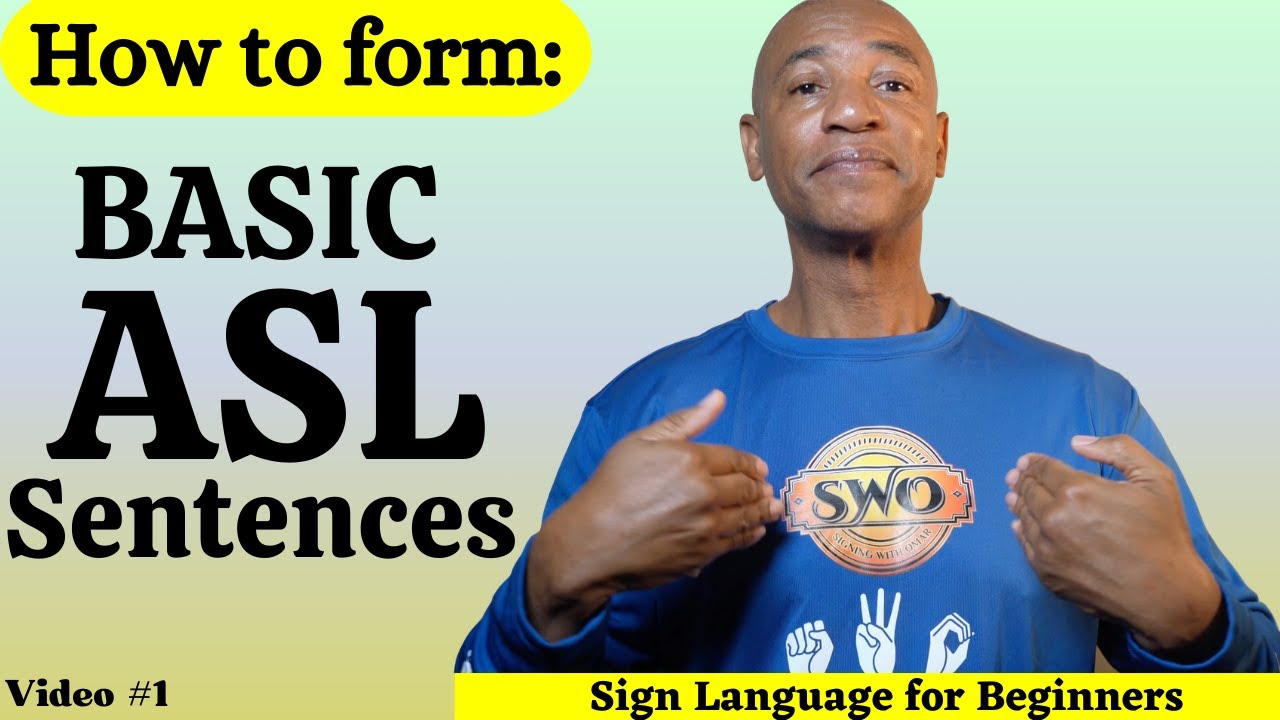
As we move beyond basic sentence structures, ASL offers sophisticated ways to express intricate thoughts and relationships between ideas. Building complex sentences involves connecting different thoughts, expressing conditions, and conveying negation with clarity and nuance. This section will explore how ASL handles these complexities, enriching your expressive capabilities.Understanding how to construct sentences with multiple clauses is key to conveying more detailed information.
This is achieved through various linguistic mechanisms that mirror the functions of conjunctions and subordinate clauses in spoken languages.
Methods for Constructing Sentences with Multiple Clauses
ASL employs several strategies to link ideas and create sentences with multiple clauses, allowing for the expression of cause and effect, temporal relationships, and elaboration. These methods often rely on specific non-manual markers, spatial arrangements, and the sequencing of signs.
- Role-Shifting: This technique involves shifting the body and facial expressions to represent different characters or viewpoints within a sentence. For instance, one clause might be signed from the perspective of person A, and the next from person B’s perspective, naturally linking their actions or dialogue.
- Topic-Comment Structure with Embedded Information: A common approach is to establish a topic and then provide a comment or elaboration about it. Complex sentences can be formed by embedding further clauses within the comment, often signaled by pauses or slight shifts in the signing space.
- Spatial Referencing: The use of established locations in the signing space to represent people, objects, or concepts can link clauses. For example, a sign performed at one location might relate to a subsequent sign performed at another, indicating a connection or sequence.
- Pauses and Transitions: Subtle pauses between segments of a sentence can indicate the separation of clauses, while specific transition signs or gestures can explicitly link them.
ASL Equivalents for Conjunctions
While ASL does not have direct, one-to-one sign equivalents for every spoken language conjunction, it uses a variety of techniques to convey the same logical relationships. These often involve non-manual markers and specific sign choices.
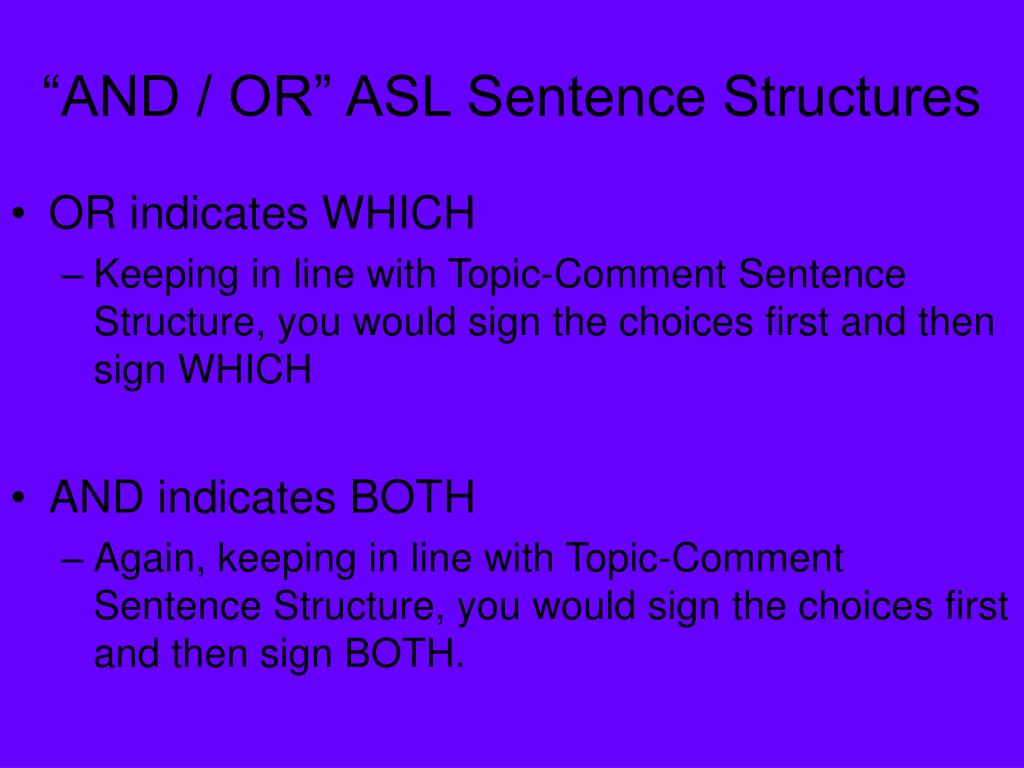
- “And”: The sign for AND is commonly used. However, for listing or sequential actions, simply signing the items or actions in order, often with a slight pause between, can convey the meaning of “and.”
- “But”: The sign BUT is used. Alternatively, a contrastive structure using role-shifting or a head shake with a specific facial expression can effectively communicate “but.”
- “Or”: The sign OR is available. In some contexts, presenting two options sequentially with a questioning or hesitant facial expression can imply “or.”
- “Because”: The sign BECAUSE is used. The order of signs can also imply causality, with the reason preceding the result.
- “So”: The sign SO is used. Similar to “because,” the sequence of signs can indicate a cause-and-effect relationship where the result follows the cause.
Expressing Conditional Statements in ASL
Conditional statements, often introduced by “if” in English, are crucial for expressing hypothetical situations and their outcomes. ASL has distinct ways to convey these, relying heavily on non-manual markers.The core structure for conditional statements in ASL involves establishing the condition first, followed by the consequence. This is primarily achieved through specific non-manual markers.
Conditional Structure: Condition (marked by raised eyebrows and forward head tilt) + Consequence (marked by neutral or specific facial expression depending on the outcome).
For example, to express “If it rains, I will stay home,” you would sign RAIN with raised eyebrows and a forward head tilt, then sign HOME STAY. The raised eyebrows and head tilt are the ASL equivalent of “if.”
Techniques for Creating Sentences Involving Negation
Negation is fundamental to expressing what is not the case. ASL utilizes several clear and distinct methods to convey negation, ensuring that the meaning is unambiguous.
- The Sign NOT: The sign NOT is the most direct way to negate a verb or concept. It is typically performed with a firm, sweeping motion.
- Head Shake: A distinct head shake, often accompanied by a specific facial expression (like a frown or pursed lips), is a powerful non-manual marker for negation. This can be used independently or in conjunction with the sign NOT.
- Negative Incorporations: Some signs have inherent negative meanings, such as NONE or WRONG.
- Negative Agreement: In some instances, negation can be shown by the directionality of a verb. For example, a verb that normally moves from subject to object might be signed in reverse or with a specific modification to indicate negation.
- Establishing a Positive and Then Negating: A common technique is to first establish a concept or action positively and then negate it. For instance, to say “I will not go,” one might sign GO, then negate it with a head shake and/or the sign NOT.
Visual and Spatial Elements in ASL Sentences
American Sign Language is a visually-oriented language, and its structure heavily relies on the use of space and visual cues to convey meaning. Understanding these elements is crucial for both producing and comprehending ASL sentences effectively. This section delves into how signers manipulate their signing space to create vivid representations of locations, relationships, and actions, enriching the grammatical and semantic content of their communication.The signing space, the area in front of the signer, is not merely a backdrop but an active participant in sentence construction.
It functions as a three-dimensional canvas where abstract concepts are made concrete through spatial arrangement and movement. This sophisticated use of space allows ASL to express complex ideas with clarity and nuance, going beyond what can be achieved with manual signs alone.
Signing Space Utilization for Locations and Relationships
The signing space is meticulously organized to represent geographical locations, the relative positions of objects, and the relationships between entities within a sentence. Signers establish “referents” by assigning specific locations in their signing space to people, places, or things. Once established, these locations are consistently used to refer back to the assigned entity, much like pronouns in spoken languages.The orientation of the handshape, the direction of movement, and the placement within the signing space all contribute to defining these spatial relationships.
For instance, a signer might point to the left to represent “my house” and then to the right to represent “your house.” Subsequent references to these locations would involve returning to those established points in space, ensuring clarity and coherence.
The Concept of “Staging” in ASL
“Staging,” also known as role-shifting or body-shifting, is a grammatical and narrative technique where a signer embodies different characters or perspectives within a sentence or discourse. This is achieved by shifting the body’s orientation, facial expressions, and hand movements to adopt the persona of the entity being represented. Staging allows for the direct portrayal of actions, dialogue, and viewpoints, adding a dramatic and engaging dimension to ASL communication.For example, when describing an interaction between two people, a signer might shift their body to the left to represent Person A speaking, then shift to the right to represent Person B responding.
This visual representation of perspective significantly enhances the clarity and richness of the narrative, making it easier for the recipient to follow the flow of information and understand the relationships between the individuals involved.
Integration of Depicting Verbs
Depicting verbs, often referred to as “mimes” or “classifiers,” are a fundamental component of ASL sentence structure, especially when describing actions, objects, and their movement or location. These signs utilize specific handshapes that represent categories of objects (e.g., vehicles, people, flat surfaces) and then move these handshapes through the signing space to illustrate the action or relationship.The integration of depicting verbs into sentence structure is highly systematic.
A signer might first establish a referent in space, then use a depicting verb to show that referent interacting with its environment or another referent. For instance, a signer might use a “vehicle classifier” to show a car driving down a road, indicating the direction and manner of movement through the manipulation of the handshape within the signing space.
Visualizing a Signed Sentence: Movement and Placement
To visualize a signed sentence, imagine a three-dimensional stage where each element is placed and moved with intention. Consider a sentence like “The dog ran across the yard to the tree.”First, the signer might establish a location for “dog” in the signing space, perhaps to the left. Then, a handshape representing a dog (e.g., a bent “V” handshape for paws) is moved across the signing space, indicating the action of running.
This movement would be directed from the established “dog” location towards a point representing “the yard.”Next, the signer would establish a location for “the tree,” perhaps further to the right. The “dog” referent, now represented by its established location, would then be shown moving towards the “tree” location. The entire movement is a spatial narrative, painting a picture of the dog’s journey across the yard.
The speed and style of the movement, along with facial expressions, would further convey the dog’s demeanor (e.g., playfully, quickly, or hesitantly).
Practical Application and Practice
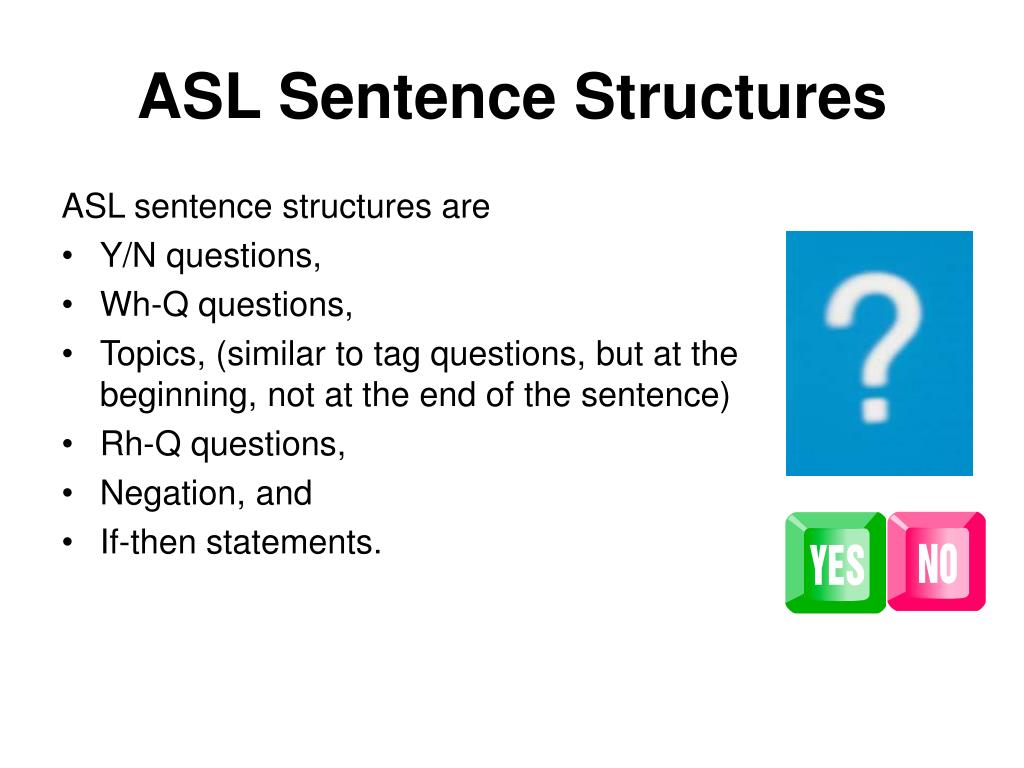
Having explored the fundamental building blocks and advanced techniques of ASL sentence structure, it’s time to translate this knowledge into tangible skills. This section focuses on providing you with structured opportunities to practice forming ASL sentences, reinforcing your understanding through active engagement. Consistent practice is key to developing fluency and accuracy in ASL, much like mastering any language.This segment offers a progressive approach to practicing ASL sentence formation.
We begin with foundational exercises designed to solidify your grasp of core components and word order, then move on to more complex scenarios that integrate non-manual markers and spatial elements. The aim is to build your confidence and competence in constructing clear, grammatically sound ASL sentences.
Organizing ASL Sentence Formation Exercises
To effectively practice ASL sentence structure, it is beneficial to organize exercises that target specific aspects of sentence construction. This systematic approach allows for focused learning and improvement.
Consider structuring your practice sessions in the following ways:
- Component Identification Drills: Focus on identifying and correctly signing individual components like subjects, verbs, and objects. Practice signing simple sentences and then break them down to analyze each part.
- Word Order Variations: Practice rearranging the core components of a sentence (Topic-Comment, Agent-Action-Object) to understand how ASL grammar allows for flexibility while maintaining clarity.
- NMM Integration: Work on incorporating appropriate non-manual markers (facial expressions, body shifts, head tilts) for different sentence types (statements, questions, commands) and to convey nuances in meaning.
- Spatial Referencing Practice: Develop the skill of establishing and referring to locations in space for characters or objects. Practice signing sentences that involve multiple people or items and require spatial referencing.
- Complex Sentence Building: Combine various elements learned previously. Start with simple sentences and gradually add clauses, descriptive elements, and temporal markers.
ASL Sentence Construction Scenarios
Applying your knowledge to real-world scenarios is crucial for developing practical ASL skills. The following scenarios are designed to prompt you to construct ASL sentences, encouraging you to think about the most effective and grammatically correct way to convey your message visually.
Here are a few scenarios to get you started:
- Scenario 1: Daily Routine Describe your morning routine from waking up to leaving the house. Include actions like waking, brushing teeth, eating breakfast, and getting dressed. Consider how you would establish yourself as the subject and use appropriate verb signs.
- Scenario 2: A Weekend Plan Imagine you are telling a friend about your plans for the upcoming weekend. You might describe going to a movie, visiting a park, or meeting someone for lunch. Think about how to introduce the topic (weekend) and then comment on your activities.
- Scenario 3: Describing an Object Choose an object in your environment (e.g., a book, a chair, a plant) and describe its appearance, its purpose, or its condition. Focus on using descriptive signs and potentially establishing the object’s location if it’s not immediately present.
- Scenario 4: A Past Event Recount a memorable event from your past, such as a birthday party or a vacation. This will involve using past tense markers and sequencing events chronologically.
- Scenario 5: Asking for Directions You are lost in a new city and need to ask for directions to a specific landmark. Formulate the question clearly, using appropriate facial expressions and mouth morphemes to indicate you are asking a question.
Self-Correction and Refining ASL Sentence Structure
Developing the ability to self-correct and refine your ASL sentence structure is a vital skill for continuous improvement. This involves critically evaluating your own signing and making adjustments for clarity and grammatical accuracy.
Employ these strategies for effective self-correction:
- Record and Review: Video yourself signing sentences. Watching yourself back allows you to observe your signing objectively, noticing any deviations from correct grammar or NMM usage.
- Analyze NMMs: Pay close attention to your facial expressions, head movements, and body shifts. Ensure they accurately reflect the intended meaning and grammatical structure (e.g., raised eyebrows for yes/no questions).
- Check Word Order: Review the order of your signs. Does it follow the common ASL structures (e.g., Topic-Comment, Agent-Action-Object)? Is the order logical and easy for a native signer to understand?
- Spatial Accuracy: If you are using spatial referencing, ensure you are consistently referring to the established locations. Are you pointing to the correct spots in space?
- Seek Feedback: Share your signed sentences with ASL tutors, fluent signers, or fellow learners. Constructive feedback is invaluable for identifying areas that need improvement.
- Compare with Native Examples: When possible, compare your sentence structures to those used by fluent ASL users in videos or real-life interactions. This provides a benchmark for accuracy.
Common Pitfalls in ASL Sentence Structuring
While learning to structure sentences in ASL, certain common pitfalls can hinder clarity and accuracy. Being aware of these potential mistakes can help you proactively avoid them and refine your signing.
Be mindful of the following common errors:
- Direct English Translation: A frequent mistake is to directly translate English sentence structures into ASL, sign-for-sign. ASL has its own unique grammar and syntax that differ significantly from English.
- Inconsistent NMMs: Failing to use or using incorrect non-manual markers can lead to misinterpretation. NMMs are integral to ASL grammar and convey crucial grammatical and emotional information.
- Lack of Spatial Referencing: Not establishing and consistently using spatial locations for people, objects, or concepts makes sentences confusing, especially when dealing with multiple entities.
- Incorrect Verb Agreement: For verbs that require movement to indicate the subject and object, incorrect agreement (e.g., signing “I help you” as “you help me” due to movement error) can completely change the meaning.
- Over-reliance on Fingerspelling: While fingerspelling has its place, overusing it instead of finding appropriate ASL signs for concepts can make signing slow and less natural.
- Ignoring Topic-Comment Structure: Not understanding or applying the Topic-Comment structure, which is very common in ASL, can lead to sentences that feel unnatural or difficult to follow for a native signer.
Ending Remarks
In conclusion, mastering the art of ASL sentence structure is a rewarding endeavor that unlocks deeper communication within the Deaf community. By understanding the topic-comment framework, the nuanced use of non-manual markers, and the dynamic interplay of visual and spatial elements, you can construct sentences that are not only grammatically sound but also rich in meaning and expression. This comprehensive overview provides the foundational knowledge and practical insights necessary to refine your ASL sentence formation, encouraging continuous practice and self-correction for fluent and effective communication.