Embarking on a culinary adventure should be accessible to everyone, and this guide, How to Order Food at a Restaurant Using Sign Language, is crafted to make dining out a seamless and enjoyable experience for the Deaf and hard-of-hearing community. We will explore the fundamental signs and strategies that empower you to communicate your needs effectively, from requesting a table to savoring your final bite.
Our aim is to equip you with the confidence and tools necessary to navigate any restaurant setting with ease.
Understanding the importance of basic sign language in a restaurant context can significantly enhance your dining experience. This guide will provide a comprehensive overview of common scenarios where sign language proves invaluable, offering a clear path towards independent and stress-free ordering. By mastering these essential communication tools, you can ensure your visit to a restaurant is both pleasant and satisfying.
Introduction to Ordering Food with Sign Language
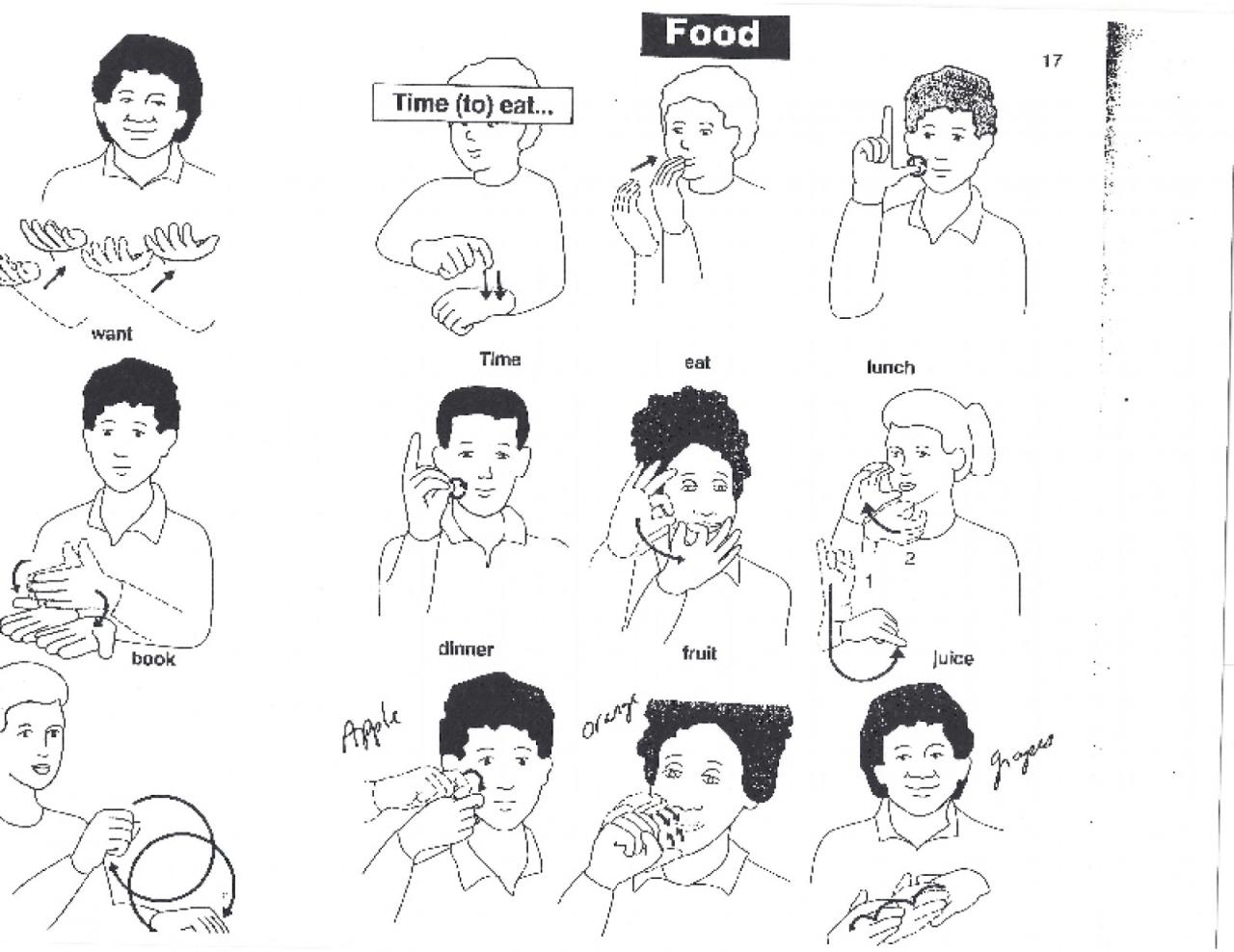
Learning basic sign language can significantly enhance the dining experience for individuals who are Deaf or hard of hearing, as well as for their hearing companions. This guide aims to bridge communication gaps in restaurant settings, ensuring that ordering food becomes a seamless and enjoyable process for everyone. By understanding and utilizing fundamental signs, diners can express their needs, preferences, and any dietary restrictions with clarity and confidence.The ability to communicate effectively in a restaurant environment is crucial for a positive social outing.
In situations where verbal communication is challenging or impossible, sign language offers a direct and expressive alternative. This is particularly beneficial in bustling restaurants where staff may not always be readily available to accommodate specific communication needs.
Benefits of Using Sign Language in Dining Settings
The integration of sign language in restaurants offers a multitude of advantages, fostering inclusivity and improving customer satisfaction. These benefits extend beyond mere convenience, contributing to a more welcoming and accessible environment for all patrons.
- Enhanced Accessibility: Sign language provides a direct communication channel for Deaf and hard-of-hearing individuals, removing barriers that might otherwise prevent them from fully participating in the dining experience.
- Improved Accuracy: By signing specific orders, preferences, and allergies, the risk of miscommunication is significantly reduced, leading to more accurate order fulfillment.
- Increased Independence: Learning to order in sign language empowers individuals to dine out with greater autonomy, without relying solely on others for communication.
- Positive Customer Experience: When restaurants are equipped to accommodate sign language, it demonstrates a commitment to inclusivity, leading to a more positive and memorable experience for Deaf patrons.
- Cultural Appreciation: For hearing individuals, learning basic signs can be an act of respect and a way to connect more deeply with Deaf culture and individuals.
Common Scenarios for Sign Language in Restaurants
Various situations within a restaurant can be made more efficient and less stressful through the use of sign language. These scenarios highlight the practical applications of learning basic signs for dining.
- Greeting and Seating: Initiating contact with the host or server, indicating the number of people in the party, and requesting a table.
- Menu Navigation: Asking for a menu, inquiring about specials, or requesting clarification on menu items.
- Placing an Order: Clearly stating the desired dishes, beverages, and any modifications or special requests.
- Communicating Dietary Needs: Informing the server about allergies, dietary restrictions (e.g., vegetarian, vegan, gluten-free), or preferences.
- Requesting Service: Signaling for the server’s attention, asking for the bill, or requesting refills.
- Expressing Satisfaction or Concerns: Providing feedback to the server about the meal or addressing any issues that may arise.
The Goal of This Guide
The overarching objective of this guide is to equip individuals with the foundational sign language skills necessary to confidently navigate the process of ordering food at a restaurant. By demystifying the process and providing practical, easy-to-learn signs, we aim to empower both Deaf and hearing individuals to engage in more inclusive and accessible dining experiences. This resource is designed to foster a sense of ease and self-assurance, transforming potential communication challenges into opportunities for connection and enjoyment.
Essential Signs for Restaurant Vocabulary
![Sign For Your Supper - Check Out A Unique Restaurant [Video]](https://tipscepat.web.id/wp-content/uploads/2025/09/vecteezy_SignLanguagefood2rev1ben0822_generated.jpg "Sign For Your Supper - Check Out A Unique Restaurant [Video]")
To effectively navigate a restaurant setting using sign language, a foundational understanding of key vocabulary is essential. This section will introduce you to the fundamental signs for places, people, and the act of ordering, as well as common food and drink categories. Mastering these signs will significantly enhance your ability to communicate your dining needs with confidence.Understanding these core concepts allows for a more fluid and less stressful dining experience.
Knowing the signs for “restaurant,” “menu,” and “waiter/waitress” helps establish the context of your interaction, while the sign for “order” is the direct catalyst for your culinary journey.
Restaurant and Personnel Signs
These are the initial signs you’ll likely use to initiate your dining experience. They help establish your location and identify the person who will assist you.
- Restaurant: Form a circle with your dominant hand, palm facing inward, and move it around in a circular motion. This signifies a place where people gather to eat.
- Menu: Hold your non-dominant hand flat, palm up. With your dominant hand, fingers together and slightly bent, tap your non-dominant palm twice. This represents opening and looking at a list of options.
- Waiter/Waitress: Extend your non-dominant arm, palm facing down, as if offering something. With your dominant hand, make a scooping motion towards yourself, as if gathering or serving. This sign is gender-neutral and indicates someone who serves.
- Order: Bring your dominant hand up to your mouth, as if speaking or making a request, and then move it forward slightly. This signifies the act of placing an order.
Food and Drink Categories
Once you’ve initiated contact and have a menu, understanding these signs will help you discuss the types of food and beverages available.It is important to familiarize yourself with these categories to efficiently communicate your preferences or to understand the menu’s structure.
- Appetizer: Bring your hands together in front of you, palms facing each other, and then move them apart slightly. This signifies a small dish served before the main meal.
- Main Course: Place your dominant hand flat on top of your non-dominant flat hand, which is held horizontally. This represents the central and most substantial part of the meal.
- Dessert: Make a “C” shape with your dominant hand and bring it to your mouth as if eating something sweet. This sign is associated with sweet treats enjoyed at the end of a meal.
- Drink: Form a “C” shape with your dominant hand and bring it to your mouth as if holding a cup or glass. This is a general sign for any beverage.
Essential Dining Actions
These signs are crucial for communicating your immediate needs and actions within the restaurant environment.Being able to convey these actions clearly ensures a smooth and comfortable dining experience for everyone involved.
- Sit: Bring your dominant hand down in a chopping motion onto your non-dominant flat palm, as if pressing down to sit.
- Eat: Bring your dominant hand, with fingers together and slightly bent, to your mouth multiple times, as if taking bites.
- Pay: Hold your non-dominant hand flat, palm up. With your dominant hand, make a flat motion across your non-dominant palm, as if handing over money.
- Thank You: Place your dominant hand flat, palm facing you, at your chin. Move your hand forward and slightly down, as if offering gratitude.
Expressing Preferences
Communicating your taste and temperature preferences is vital for receiving your food and drinks exactly as you like them.These signs allow you to fine-tune your order and ensure your dining experience is perfectly tailored to your liking.
- Hot: Form a “V” shape with your dominant hand, fingers pointing upwards. Move your hand up and down quickly, as if indicating heat or steam.
- Cold: Shiver with your body, or rub your arms as if you are cold. Alternatively, form a fist with your dominant hand and tap it against your chest, then open your hand outward, as if experiencing a chill.
- Spicy: Bring your dominant hand, with index finger extended, to your mouth, and then move it away with a slight flick of your wrist, as if experiencing a burning sensation.
- Mild: Place your dominant hand flat, palm down, and gently move it back and forth, indicating a gentle or not strong flavor.
Navigating the Menu Using Sign Language
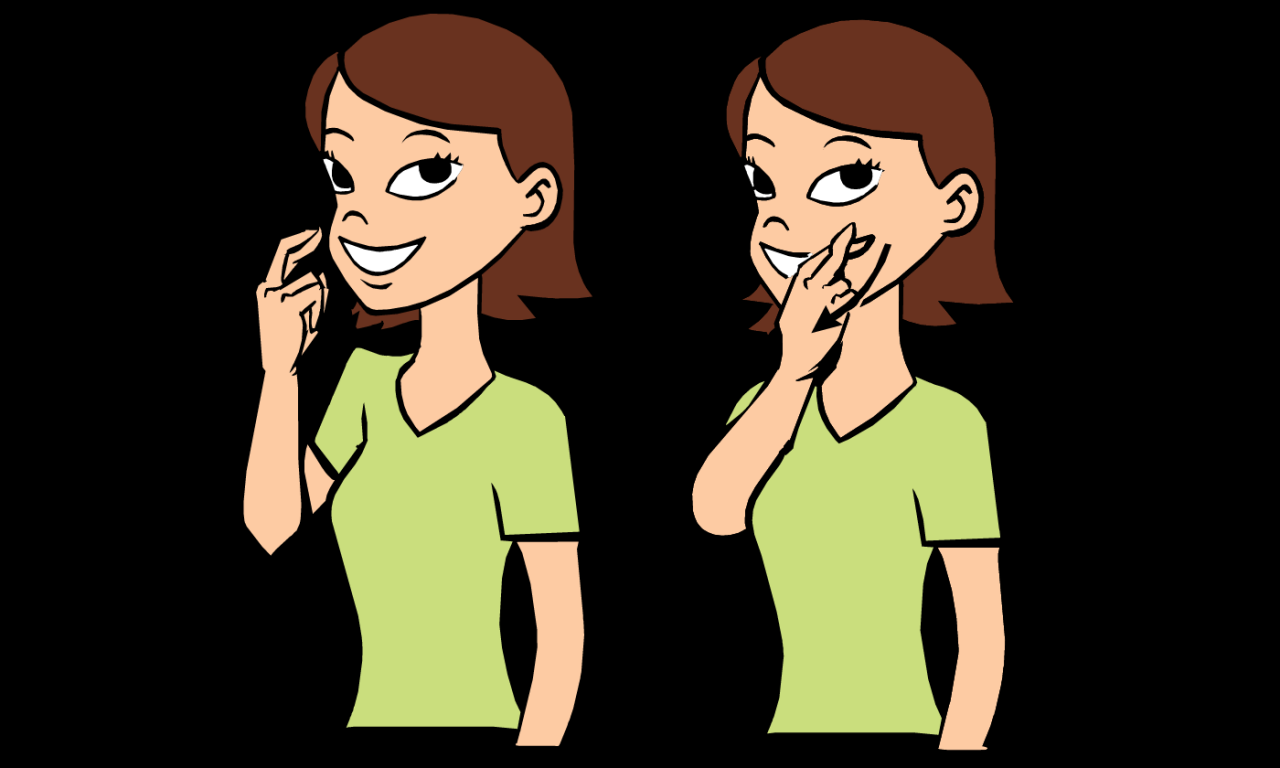
Exploring a restaurant menu can be a delightful experience, and with the right signs, it becomes accessible and enjoyable for everyone. This section will guide you through the essential signs for interacting with a menu, ensuring you can confidently make your selections. Understanding how to request and interpret a menu in sign language empowers you to fully participate in the dining experience.
We will cover the steps from asking for the menu to making specific choices and inquiring about dietary needs.
Requesting the Menu
When you are ready to view the offerings, you can politely request the menu using a specific sign. This simple gesture ensures that the server understands your intention to see the available dishes and drinks. To ask for the menu, you will typically use a combination of signs.
- The sign for “MENU” is often performed by making a flat hand and moving it back and forth horizontally in front of you, mimicking the opening and closing of a book.
- You can then add the sign for “PLEASE” (rubbing your fist on your chest in a circular motion) to make the request polite.
- Combining these signs, “MENU PLEASE,” clearly communicates your need.
Indicating Menu Choices
Once you have the menu, you’ll need a way to point out what you’d like to order. This can be done by directly pointing to the item on the menu or by using specific signs for the dishes you’ve chosen. There are several effective methods for indicating your selections from the menu.
- Pointing: The most straightforward method is to clearly point to the item on the physical menu. Ensure your point is unambiguous and directed at the specific dish or drink you desire.
- Signing Specific Items: If you know the sign for a particular dish (e.g., “PIZZA,” “SALAD,” “WATER”), you can use that sign while looking at the menu. This is particularly useful if the menu is large or if you want to confirm your choice verbally in sign.
- Describing: If you are unsure of the exact name but can describe the item (e.g., “CHICKEN SOUP”), you can use signs for the components and the general type of dish.
It is also helpful to learn the signs for common categories like “APPETIZER,” “MAIN COURSE,” and “DESSERT” to navigate the menu structure.
Inquiring About Ingredients and Dietary Restrictions
It is crucial to be able to ask about ingredients and any potential dietary concerns. This ensures your meal is safe and enjoyable, especially if you have allergies or follow specific dietary guidelines. Communicating your dietary needs effectively is a vital part of ordering food.
- Ingredients: To ask about ingredients, you can sign “WHAT” (index finger tapping your chin) followed by “INSIDE” (making fists and bringing them together, then separating them). You can then point to the menu item. A more direct way is to sign “INGREDIENTS” (making fists and moving them back and forth, as if sifting).
- Allergies: To inquire about allergies, sign “ALLERGY” (tapping your wrist with your index finger). You can then specify the allergen, for example, “PEANUT ALLERGY” (sign PEANUT, then ALLERGY).
- Dietary Restrictions: For general dietary restrictions, you can use signs like “VEGETARIAN” (index finger pointing upwards, then tracing a circle), “VEGAN” (sign VEGETABLE, then VEGAN, which is similar to vegetarian but with a more emphatic motion), or “GLUTEN-FREE” (sign GLUTEN, then FREE). You can also combine these with “NO” (shaking your hand from side to side). For example, “NO GLUTEN” or “VEGETARIAN OPTION?” (sign VEGETARIAN, then OPTION – a circling motion with your index finger).
A useful phrase to remember is “ANYTHING WITH [ingredient]?” which can be signed by pointing to the ingredient and then signing “WITH” (bringing your index fingers together).
Asking for Recommendations
When you are undecided or wish to explore the restaurant’s specialties, asking for recommendations is a great way to discover new favorites. This can be done effectively using sign language. Seeking a recommendation can lead to delightful culinary discoveries.
- The most common way to ask for a recommendation is to sign “RECOMMEND” (making a fist and rotating it on your chest) or “SUGGEST” (making a flat hand and moving it from your chin outwards).
- You can then add “WHAT?” or “BEST?” (making a “B” handshape and tapping your chin twice) to indicate you are looking for their top choices.
- To be more specific, you can ask for recommendations within a category, such as “RECOMMEND APPETIZER?” or “BEST MAIN COURSE?”
- If you have preferences, you can incorporate them, for example, “RECOMMEND SPICY?” (sign SPICY – making a fist and moving it away from your mouth as if tasting something hot) or “RECOMMEND LIGHT?” (sign LIGHT – making a flat hand and moving it upwards as if something is floating).
A helpful phrase to use is “WHAT IS YOUR FAVORITE?” which can be signed by pointing to the server and signing “FAVORITE” (making a flat hand and tapping your index finger on your chin).
Placing Your Order
This section focuses on the crucial step of communicating your food and beverage choices to the server using sign language. Mastering these signs will ensure your dining experience is smooth and enjoyable, allowing you to confidently express your preferences and any necessary adjustments.
Ordering Specific Dishes and Beverages
To effectively order, you will need to learn the specific signs for the items on the menu. These signs often involve depicting the shape or action associated with the food or drink. It is highly recommended to familiarize yourself with the signs for common dishes and beverages before your visit.Here are some common signs for ordering:
- Water: Sign the letter ‘W’ with your dominant hand and bring it to your mouth as if drinking.
- Coffee: Mimic holding a coffee cup with your dominant hand and bringing it to your lips.
- Tea: Sign the letter ‘T’ with your dominant hand and bring it to your mouth as if drinking.
- Juice: Sign the letter ‘J’ with your dominant hand and bring it to your mouth.
- Soda/Pop: Mimic opening a can by pulling a tab upwards with your dominant hand.
- Salad: Use your dominant hand to make a chopping motion, as if preparing vegetables.
- Soup: Mimic holding a spoon and bringing it to your mouth.
- Sandwich: Place your non-dominant hand flat and then place your dominant hand on top, mimicking a sandwich.
- Pizza: Form a circle with your dominant hand and then make a slicing motion.
- Burger: Mimic holding a burger and taking a bite.
- Pasta: Use your dominant hand to twirl an imaginary fork with pasta.
- Chicken: Make a flapping motion with your arm, as if a chicken’s wings.
- Beef/Steak: Mimic holding a knife and fork and cutting a piece of meat.
- Fish: Make a wave-like motion with your hand, representing a fish swimming.
Specifying Quantity
Accurately communicating the number of items you wish to order is essential. You can use your fingers to represent numbers, or learn specific signs for quantities.The following are common ways to indicate quantity:
- One: Hold up one finger.
- Two: Hold up two fingers.
- Three: Hold up three fingers.
- Four: Hold up four fingers.
- Five: Hold up five fingers.
- Six: Hold up your hand with thumb and pinky extended, then bring your index and middle finger down to touch the thumb.
- Seven: Hold up your hand with thumb and pinky extended, then bring your index and middle finger down to touch the thumb, then bring your ring finger down to touch the thumb.
- Eight: Hold up your hand with thumb and pinky extended, then bring your index, middle and ring finger down to touch the thumb.
- Nine: Hold up your hand with thumb and pinky extended, then bring your index, middle, ring and pinky finger down to touch the thumb.
- Ten: Make a fist with your dominant hand.
- Many/Several: Use a circular motion with your hand, as if indicating a group.
For larger quantities, you can use a combination of signs or the sign for “many.” For instance, to order “three coffees,” you would sign “coffee” and then hold up three fingers.
Modifications to an Order
Restaurants are often accommodating to special requests. Learning signs for common modifications will allow you to tailor your order to your dietary needs or preferences.Here are signs for common order modifications:
- No/Without: Form a fist with your dominant hand and then move it away from your non-dominant hand in a sharp, decisive motion.
- Extra/More: Sign the letter ‘E’ with your dominant hand and move it forward in a sweeping motion.
- Onions: Mimic peeling an onion with your dominant hand.
- Sauce: Use your dominant hand to make a scooping motion, as if taking sauce with a spoon.
- Spicy: Make a fanning motion in front of your mouth, as if fanning away heat.
- Mild: Gently pat your chest with your dominant hand.
- Allergy: Sign the letter ‘A’ with your dominant hand and then move it across your throat.
For example, to order a burger with “no onions,” you would sign “burger,” then “no,” and then “onions.” To request “extra sauce” on your pasta, you would sign “pasta,” then “extra,” and then “sauce.”
Confirming the Order
Before the server leaves, it is good practice to confirm your order to ensure accuracy. This can be done by gesturing and signing the items you believe you ordered.To confirm your order, you can:
- Point to yourself and then sign the items you ordered. This visually reiterates your choices.
- Gesture to the server and then sign the items. This prompts them to acknowledge or correct.
- Use a questioning facial expression combined with the signs for your order. This invites confirmation.
For instance, after ordering, you might point to yourself, sign “burger,” “fries,” and “water,” with a slight head tilt and raised eyebrows, to ensure the server understood and will bring those items.
Interacting with Restaurant Staff
Effectively communicating with restaurant staff is a crucial part of the dining experience, especially when using sign language. This section will guide you through essential signs to ensure smooth interactions, from getting attention to expressing your satisfaction.
Getting Server’s Attention
When you need to signal a server, it’s important to do so politely and clearly. A gentle wave with an open hand, palm facing the server, is a universally understood gesture. In sign language, a specific sign can also be used to convey this request.A common and effective way to get a server’s attention is by using a simple, upward flick of the index finger, while maintaining eye contact.
This gesture is discreet and respectful. Alternatively, a slight nod of the head combined with a brief, open-handed wave can also be effective.
Requesting Assistance or Clarification
There may be times when you require assistance or need clarification on something. Knowing the appropriate signs can make these interactions efficient and stress-free.Here are some essential signs for requesting help:
- Help: Form a fist with your dominant hand, then bring it to your chest, opening your hand as if offering assistance.
- Question: Hold your index finger up and point it towards the person you are addressing, then make a slight circular motion.
- Understand: Touch your forehead with your index finger, then move it forward and down, as if an idea is dawning.
- Repeat: Form the letter ‘R’ with your dominant hand and move it in a small circular motion in front of you.
- More: Touch the tips of your thumb and index finger together, then open and close them a few times.
Requesting the Bill and Payment
When it’s time to settle the bill, clear communication is key. Sign language offers specific ways to signal this to your server.To request the bill, you can mime writing on your palm with your index finger. This gesture is widely understood. Another effective sign involves bringing your hands together as if holding a book or check and then moving them apart.When you are ready to pay, you can also use the sign for “bill” followed by a nod or a gesture indicating “now.” If you wish to specify a payment method, you can sign “credit card” or “cash” after requesting the bill.
Expressing Satisfaction or Dissatisfaction
Providing feedback about your dining experience is important for both you and the restaurant. Sign language allows you to express your feelings clearly.To express satisfaction, a simple and universally recognized sign is a thumbs-up. You can also use a smile and a nod. In sign language, a more specific sign for “good” or “delicious” involves touching your chin with your thumb and then moving your hand forward with your palm facing upwards.Conversely, if you are dissatisfied, it’s important to communicate this politely.
A thumbs-down gesture can indicate disapproval. For more specific feedback, you might use signs for “not good” or “problem.” It is always advisable to approach staff calmly and use clear, concise signs to convey your concerns.
Handling Common Dining Situations
Navigating a restaurant experience extends beyond simply placing an order. This section will equip you with the necessary signs and strategies to manage various common dining scenarios, ensuring a smooth and enjoyable meal. We will cover custom orders, group ordering, addressing misunderstandings, and communicating dietary needs effectively.
Custom Meal Orders
Ordering a meal exactly to your preferences is a common request. Being able to clearly communicate modifications can significantly enhance your dining experience. The following signs will help you articulate specific changes to your dishes.To order a custom meal, you will need to combine signs for the base dish with signs for modifications. For instance, if you want a burger without onions, you would sign “BURGER” followed by “NO” and “ONION.”Here are some essential signs for customizing your order:
- NO: A flat hand moves horizontally across the chest.
- ADD: Fingers of one hand tap against the palm of the other.
- SPICY: Fingers of one hand wiggle downwards from the chin.
- EXTRA: Both hands form fists and move outwards from each other.
- WITHOUT: A sweeping motion with an open hand from the chest outwards.
- ONION: Index finger taps the side of the nose.
- CHEESE: Fingers of one hand interlock with fingers of the other.
- SAUCE: A “C” handshape moves in a circular motion.
For example, to request a salad with dressing on the side, you would sign “SALAD,” then “DRESSING,” then “SIDE” or “SEPARATE.” If you want your steak well-done, you would sign “STEAK” followed by “WELL-DONE.”
Ordering for Multiple People
When dining with a group, efficient communication is key to ensuring everyone receives their correct order. You can order for yourself and then for others, or indicate that you are ordering for the entire table.To order for multiple people, you can first establish the number of people you are ordering for. You can then sign “YOU” or point to individuals and sign their respective orders.
Alternatively, you can order for yourself and then sign “NEXT” or “ANOTHER” for the next person’s order.Here are some useful signs for group ordering:
- PERSON: Both hands form fists and move up and down alternately.
- WE: Point to yourself and then sweep outwards to include others.
- ALL: A circular motion with an open hand over the group.
- NEXT: An index finger points forward, followed by the other index finger.
- SAME: Both index fingers point upwards and move up and down together.
For example, if you are ordering for three people, you might start by signing “THREE PEOPLE.” Then, you can sign “I WANT…” for your order, followed by “NEXT PERSON” and their order. If everyone wants the same dish, you can sign “WE ALL WANT [dish name]” or “SAME [dish name] FOR ALL.”
Addressing Order Misunderstandings or Errors
Mistakes can happen in any restaurant setting. Knowing how to politely and clearly communicate an error in your order is essential for a positive resolution. The following signs will help you address misunderstandings or incorrect items.When an error occurs, remain calm and polite. Use clear and direct signs to explain the issue. It is often helpful to point to the incorrect item or the item that is missing.Here are signs to use when dealing with misunderstandings or errors:
- WRONG: One hand taps the back of the other hand.
- NOT THIS: An open hand moves downwards with a shaking motion.
- MISSING: Fingers of one hand point to an empty space.
- ORDER: Both hands form fists and move up and down alternately, as if stirring.
- CHECK: Both index fingers point upwards and move towards each other.
- AGAIN: A hand forms a “G” shape and moves in a circular motion.
- EXPLAIN: Fingers of one hand trace a line on the palm of the other.
For instance, if you received chicken instead of fish, you would sign “FISH” and then “NOT THIS,” followed by “CHICKEN” and “WRONG.” If an item you ordered is missing, you would sign “ORDER” and then point to the missing item’s place and sign “MISSING.”
Requesting Dietary Accommodations
Communicating dietary needs is crucial for safety and comfort. Restaurants are generally accommodating, but clear communication using specific signs is necessary.To ensure your dietary needs are met, it is best to inform the server early in the ordering process. You can use specific signs to indicate allergies, dietary preferences, or restrictions.Here are signs for requesting dietary accommodations:
- ALLERGY: Both index fingers tap each other repeatedly.
- VEGETARIAN: A flat hand moves upwards from the chin.
- VEGAN: A “V” handshape is traced on the chest.
- GLUTEN-FREE: Sign “WHEAT” (fingers of one hand tap the palm of the other) and then sign “NO.”
- DAIRY-FREE: Sign “MILK” (fingers of one hand move up and down as if milking a cow) and then sign “NO.”
- NUT: A fist taps against the side of the head.
- SHELLFISH: Fingers of one hand make a pinching motion.
For example, if you have a peanut allergy, you would sign “ALLERGY” and then “NUT.” If you are vegetarian, you would sign “VEGETARIAN.” You can combine these signs, such as “I AM ALLERGY [specific allergen]” or “I AM VEGETARIAN.” It is also helpful to ask if a dish can be prepared without certain ingredients by signing “[dish name]” followed by “[ingredient]” and “NO.”
Visual Aids and Resources for Learning
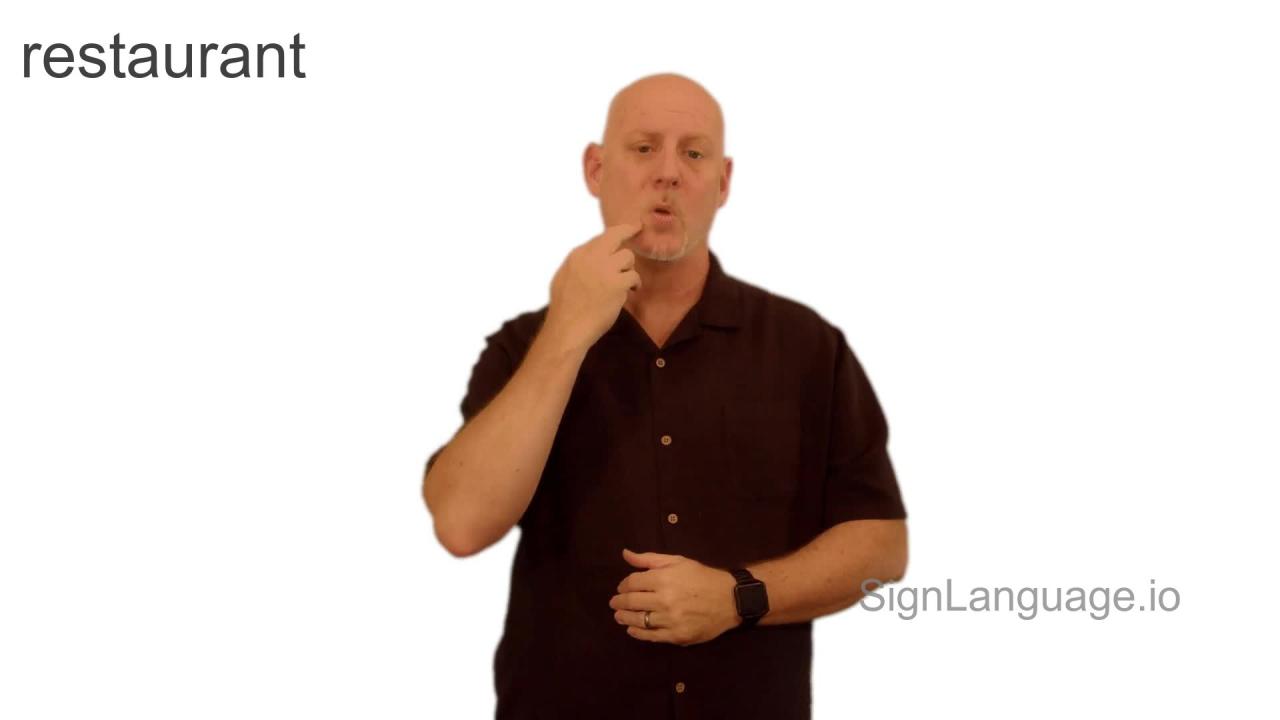
To effectively learn and retain sign language vocabulary for ordering food, incorporating visual aids and engaging in consistent practice is paramount. These tools and methods can significantly enhance comprehension and fluency, making the learning process more dynamic and accessible.Visual aids serve as powerful anchors for memory, especially when learning a new language. They provide a concrete representation of abstract signs, bridging the gap between the visual gesture and its meaning.
Types of Visual Aids for Learning Sign Language
Various visual aids can be employed to facilitate the learning of restaurant-related sign language. These resources offer different modalities for understanding and practicing signs, catering to diverse learning styles.
- Flashcards: Create or utilize pre-made flashcards featuring a sign on one side and its meaning (and potentially a descriptive image) on the other. This is excellent for quick recall and self-testing.
- Videos and Online Tutorials: Platforms like YouTube and dedicated sign language learning websites offer countless videos demonstrating signs in motion. Observing native signers is crucial for understanding the nuances of handshape, movement, and facial expression.
- Diagrams and Illustrations: Step-by-step diagrams illustrating the formation of a sign can be very helpful for beginners. These can be found in textbooks or online resources.
- Infographics: Visually appealing infographics can summarize key vocabulary sets or grammar points related to dining, making information digestible and memorable.
- Real-Life Object Association: Pointing to actual food items or restaurant elements while practicing the corresponding sign reinforces the connection between the sign and its real-world referent.
Methods for Practicing and Reinforcing Sign Language Vocabulary
Consistent and varied practice is essential for solidifying learned signs and building confidence. Engaging in active recall and application will accelerate your proficiency.
- Role-Playing: Simulate ordering scenarios with a friend, family member, or even by yourself. Practice both the customer and server roles.
- Sign Language Games: Develop or participate in games like Pictionary (drawing signs for others to guess), charades (acting out signs), or matching games (matching signs to their meanings).
- Vocabulary Journals: Keep a dedicated notebook or digital document where you write down new signs, their meanings, and draw simple representations. Regularly review these entries.
- Mirror Practice: Use a mirror to observe your own signing. This helps you refine your handshapes, movements, and overall clarity.
- Contextual Learning: When learning a new sign, try to immediately use it in a sentence or a simulated conversation. This embeds the sign within a practical context.
Using Descriptive Gestures to Supplement Learned Signs
While learning specific signs is vital, the ability to use descriptive gestures can significantly enhance communication, especially when you are still building your vocabulary. These gestures act as a bridge, conveying meaning when a direct sign might not be known or remembered.Descriptive gestures are often intuitive and draw from universal forms of communication. They help to clarify intent and provide additional information that the learned signs might not fully encompass.
- Illustrating Size and Shape: Use your hands to show the size of a dish (e.g., cupping hands for a bowl, spreading hands for a large plate) or the shape of food items (e.g., forming a circle for a pizza, a long shape for a baguette).
- Indicating Actions: Mimic actions related to eating or drinking, such as bringing a hand to your mouth to indicate eating, or pretending to sip from a cup.
- Expressing Taste and Texture: Use facial expressions and hand movements to convey taste (e.g., a grimace for sour, a smile for sweet) or texture (e.g., a smooth motion for creamy, a rough motion for crunchy).
- Describing Ingredients: If you don’t know the sign for a specific ingredient, you can gesture its general appearance or source (e.g., pointing to your stomach for “meat” if you don’t know the sign, or mimicking a plant for “vegetable”).
- Conveying Urgency or Need: Gestures like tapping your watch can indicate a time constraint, or repeatedly pointing to your empty glass can signify thirst.
Supplementary Resources for Further Learning
Expanding your learning beyond basic vocabulary will foster a deeper understanding and greater confidence in using sign language in a restaurant setting. These resources offer comprehensive learning pathways.A variety of supplementary resources can aid in continuous learning and skill development. Exploring these options will provide a robust foundation for mastering sign language for dining.
- American Sign Language (ASL) Dictionaries: Online and physical dictionaries provide a vast library of signs with clear definitions and often video demonstrations. Websites like Signing Savvy or the ASL Dictionary are excellent starting points.
- Deaf Community Centers and Organizations: Connecting with local Deaf community centers or organizations can provide opportunities for immersion, workshops, and interaction with fluent signers.
- Sign Language Apps: Numerous mobile applications are designed for learning ASL, offering interactive lessons, vocabulary builders, and quizzes.
- ASL Books and Workbooks: Comprehensive textbooks and workbooks offer structured lessons, exercises, and explanations of ASL grammar and culture.
- Online ASL Courses: Many universities and private institutions offer online ASL courses that provide structured learning from beginner to advanced levels.
- Deaf Culture Resources: Understanding Deaf culture is integral to effective communication. Resources that discuss Deaf history, etiquette, and social norms can enhance your overall fluency and respect for the language.
Closing Notes
In conclusion, mastering the art of ordering food at a restaurant using sign language opens up a world of culinary possibilities. This guide has equipped you with the essential vocabulary and practical strategies to confidently interact with restaurant staff, express your preferences, and handle various dining situations. We hope this resource empowers you to enjoy your dining experiences to the fullest, fostering greater independence and connection.