This guide offers a comprehensive approach to navigating a coffee shop using American Sign Language. We will explore essential ASL phrases and vocabulary, from initial greetings to ordering your favorite beverage and engaging in pleasantries with the barista. Understanding these fundamental aspects will empower you to confidently interact in this common social setting.
Our journey will cover the nuances of ASL, including the importance of non-manual markers and body language, which are crucial for conveying tone and meaning. We’ll delve into practical scenarios, such as handling common requests and clarifications, ensuring a smooth and enjoyable experience for both you and your service provider.
Introduction to ASL for Coffee Shop Interactions
Learning American Sign Language (ASL) can significantly enhance your experience in everyday situations, and a coffee shop is an excellent place to practice. For Deaf or hard-of-hearing individuals, ASL is their primary language, and being able to communicate in ASL fosters inclusivity and a more welcoming environment. Even for hearing individuals, learning basic ASL for coffee shop interactions demonstrates respect and opens up a new avenue for connection.
This section will guide you through the foundational ASL elements crucial for ordering coffee, asking questions, and engaging in simple conversations.The ability to use ASL in a coffee shop setting bridges communication gaps, ensuring that everyone feels valued and understood. It moves beyond written notes or pointing, allowing for a more natural and personal exchange. Mastering a few key phrases and vocabulary words can transform a routine coffee run into a positive social interaction.
Common Greetings and Polite Phrases in ASL
Initiating contact with a friendly greeting and using polite phrases are universal in fostering positive interactions. In ASL, these expressions convey respect and a willingness to communicate. Understanding and using these signs effectively will make your interactions smoother and more pleasant.Here are some essential ASL greetings and polite phrases:
- HELLO: A simple, open-handed wave near the forehead.
- GOOD MORNING/AFTERNOON/EVENING: Combine the sign for GOOD (palm facing you, move hand down) with the sign for MORNING (sun rising), AFTERNOON (hand in an L-shape moving across the face), or EVENING (dominant hand resting on non-dominant forearm).
- PLEASE: Flat palm placed on the chest and moved in a circular motion.
- THANK YOU: Flat palm moves from the chin forward and slightly down.
- YOU’RE WELCOME: Similar to THANK YOU, but the hand moves from the chin outwards.
- EXCUSE ME: Two index fingers tap each other lightly in front of you. This is used to get someone’s attention politely.
- SORRY: Make a fist and rub it in a circular motion on your chest.
“Polite signs are the foundation of respectful communication.”
Basic ASL Vocabulary for Coffee Shop Items
Navigating a coffee shop requires knowing the signs for common items and actions. Having this vocabulary readily available will allow you to confidently order your preferred beverages and snacks, as well as ask for modifications or additional items.Here is a selection of essential ASL vocabulary for coffee shop environments:
| English Word | ASL Sign Description |
|---|---|
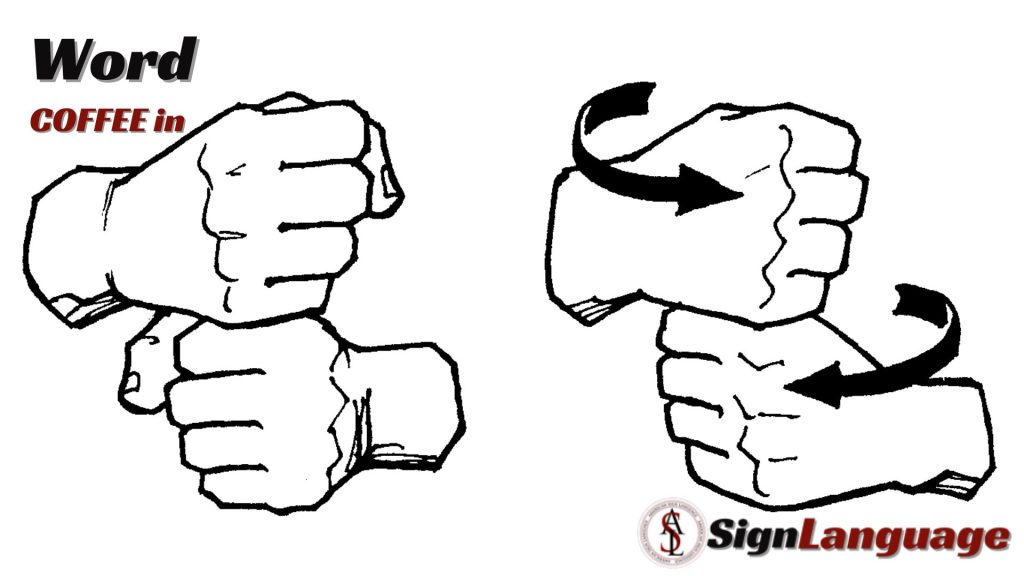
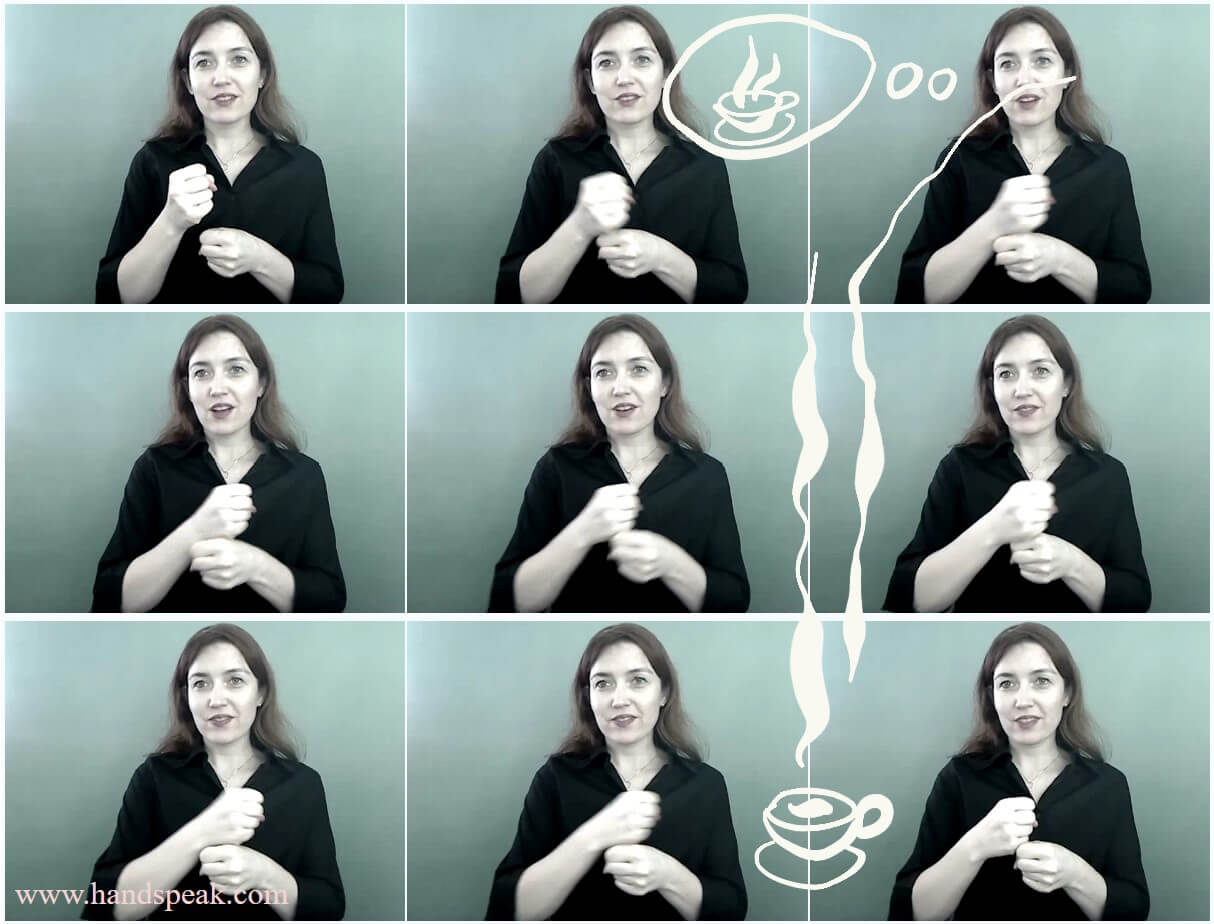
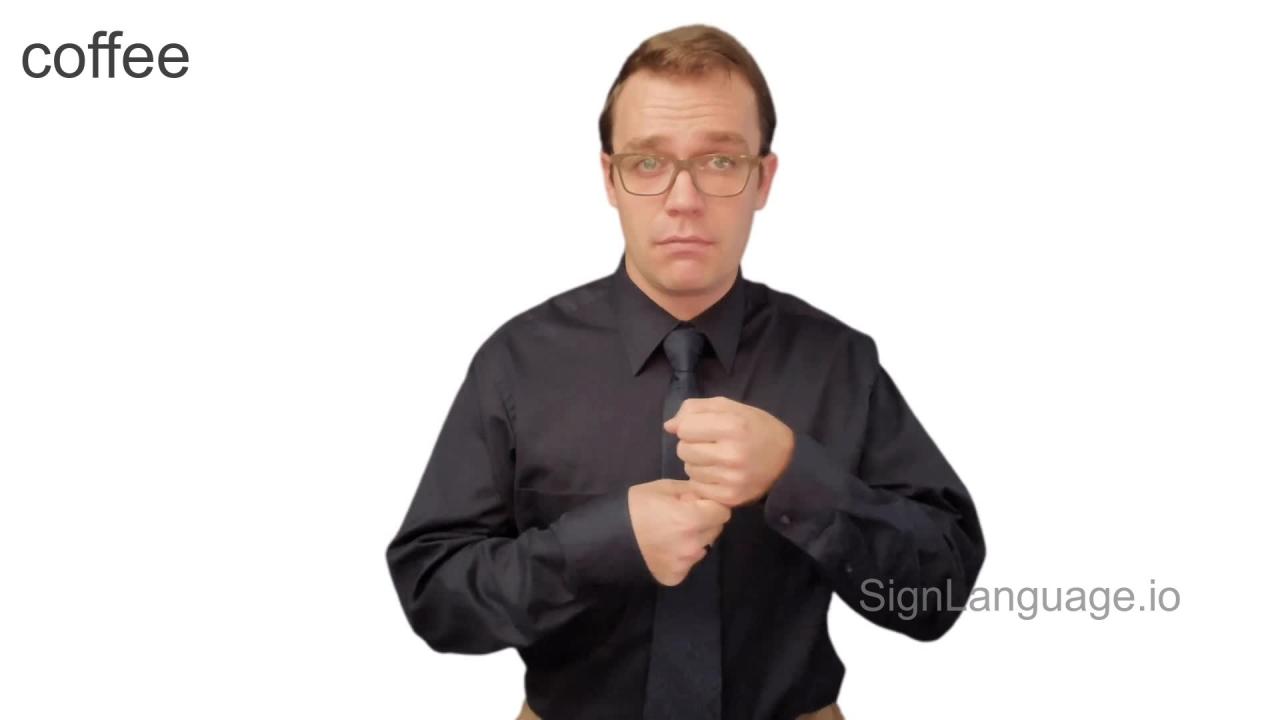
| COFFEE | Make two fists, then move them in a circular motion as if grinding coffee beans. |
| TEA | Form a “C” shape with your dominant hand and bring it to your mouth as if drinking from a cup. |
| WATER | Make a “W” shape with your dominant hand and tap your chin twice. |
| MILK | Open your hand, palm facing up, and move it downwards in a milking motion. |
| SUGAR | Make a fist and rub your thumb and index finger together, as if pinching sugar. |
| CUP | Form a “C” shape with your dominant hand and cup it as if holding a mug. |
| TO GO | Make a fist with your dominant hand and move it forward, as if walking away. |
| FOR HERE | Point to yourself, then point to the table or counter. |
| SIZE (Small, Medium, Large) | Small: Form a small circle with your thumb and index finger. Medium: Form a larger circle. Large: Extend your arms wide. |
| ORDER | Place your dominant hand flat on top of your non-dominant hand, then flip the dominant hand over. |
Practicing these signs regularly will build your confidence and fluency when ordering at a coffee shop, ensuring a smooth and enjoyable experience for everyone involved.
Ordering Coffee and Other Items
This section will guide you through the essential ASL signs and phrases needed to confidently order your favorite coffee and other items at a coffee shop. Mastering these will allow for smooth and clear communication.To initiate your order, you’ll want to use a polite and direct phrase. The most common and versatile ways to express your desire for something are by signing “I would like…” or “Can I have…”.
These phrases are fundamental for any transaction.
Essential Ordering Phrases
It is important to know how to politely request items. The following phrases are key to starting your order effectively.
I would like…: Sign ‘I’ (point to yourself), then ‘WANT’ (closed fist, thumb up, moving forward from your chest) or ‘LIKE’ (flat hand, fingers touching chest, moving slightly forward).
Can I have…?: Sign ‘CAN’ (fist, thumb up, tapping down twice) followed by ‘HAVE’ (flat hands, palms up, moving towards you).
Types of Coffee
Understanding the ASL signs for common coffee beverages will enhance your ordering experience. Familiarize yourself with these to clearly communicate your choice.
- Latte: Sign ‘MILK’ (open hand, fingers spread, stroking down your arm) followed by ‘COFFEE’ (fist, thumb up, rotating in a circle near your mouth).
- Americano: Sign ‘BLACK COFFEE’ (as described below) and then add a sign for ‘WATER’ (index finger pointing up, moving towards your mouth).
- Black Coffee: Sign ‘COFFEE’ (as described above) and then sign ‘BLACK’ (index finger tracing a line from your forehead down to your chin).
- Espresso: Sign ‘SMALL’ (hands held apart to indicate a small size) followed by ‘COFFEE’.
Specifying Preferences
Once you’ve chosen your drink, you’ll likely want to specify details like size, milk type, and sugar. These modifiers ensure you receive your order exactly as you like it.
Drink Size
Communicating the size of your beverage is straightforward with these signs.
- Small: Hold your hands apart to show a small distance.
- Medium: Hold your hands a moderate distance apart.
- Large: Hold your hands farther apart to indicate a larger size.
Milk and Sweetener Preferences
Your choice of milk and sweetener can be clearly conveyed with specific signs.
- Milk: Sign ‘MILK’ (open hand, fingers spread, stroking down your arm). You can then add signs for specific milk types if known, or use classifiers to describe them. For example, for ‘almond milk’, you might sign ‘ALMOND’ (index finger and thumb forming a circle, then tapping the circle) followed by ‘MILK’.
- Sugar: Sign ‘SUGAR’ (flat hand, fingers together, moving in a circular motion near your mouth).
- No Sugar: Sign ‘SUGAR’ followed by a negation sign (shaking your head and signing ‘NOT’ or a quick flick of your hand away from your mouth).
Ordering a Pastry
Here is a simple dialogue demonstrating how to order a pastry. This scenario assumes you have already ordered your drink. Customer: (Points to the pastry display)”I would like that one.” (Signs ‘PASTRY’ – typically a sign that mimics holding a small baked good, or a classifier showing its shape, followed by ‘THAT’ and pointing to the desired item). Barista: (Nods) “Okay.” (May sign ‘PASTRY’ and point to confirm).
Customer: (If ordering multiple, signs the number, e.g., ‘TWO’ or ‘THREE’, followed by the sign for ‘PASTRY’ or a classifier). Barista: (Confirms the order and the price).
Engaging in Basic Conversation
Building on your ability to order, the next step in a comfortable coffee shop experience is engaging in simple conversation. This allows for a more personal interaction with the barista and can make your visit more enjoyable. These basic conversational elements are fundamental to creating a friendly atmosphere.Small talk is a universal way to connect, and in ASL, it’s no different.
Knowing a few key phrases can open the door to brief, pleasant exchanges. These signs are designed to be approachable and easy to understand, even for those new to ASL.
Common Small Talk Topics
Initiating conversation often involves discussing the immediate environment or the current day. These topics are neutral and universally relatable, making them excellent starting points.Here are ASL signs for common small talk topics:
- Weather: The sign for “WEATHER” involves tapping your dominant index finger to your chin twice. To ask about the weather, you would sign WEATHER and then raise your eyebrows and tilt your head slightly. A common response might involve signs like SUNNY (open hand, palm down, moves in a circular motion), RAINY (index finger and middle finger extended, wiggling down like rain), or CLOUDY (hands cupped together, moving back and forth).
- The Day: To refer to “TODAY,” you sign DAY (dominant hand forms a flat “C” shape, moves down in a slight arc) and then point to yourself or the current time. You can also ask “HOW IS YOUR DAY?” by signing HOW (both hands in a fist, palms facing each other, then rotate outwards) and then DAY, followed by YOU.
Asking and Responding to “How Are You?”
The universally recognized greeting “How are you?” has a direct and commonly used ASL equivalent. This phrase is essential for politeness and initiating a friendly exchange.The ASL phrase for “HOW ARE YOU?” is typically signed by forming both hands into a fist, palms facing each other, and then rotating them outwards. To respond, you can use signs like:
- GOOD: Dominant hand flat, palm facing you, moves from your chin outwards.
- FINE: Dominant hand forms a flat “B” shape, palm facing you, moves from your chin outwards.
- TIRED: Dominant hand forms a flat “B” shape, palm facing down, moves down your chest.
- SO-SO: Dominant hand moves back and forth horizontally, palm facing down.
A common conversational flow would be:
- Barista signs: HOW YOU? (or HOW ARE YOU?)
- You respond: GOOD, YOU? (or FINE, YOU?)
- Barista responds: GOOD.
Expressing Likes and Dislikes
Sharing your preferences adds a personal touch to the interaction. Being able to express what you enjoy or don’t enjoy, especially regarding the coffee shop’s offerings, can lead to more tailored recommendations or simply a more engaging conversation.To express likes and dislikes in ASL:
- LIKE: Dominant hand forms a flat “A” shape, thumb extended, and pulls away from your chest.
- DISLIKE: The sign for “LIKE” performed with a negative facial expression, or by signing LIKE and then shaking your head “no.”
You can use these signs in various contexts within the coffee shop:
- To express enjoyment of the coffee: “I LIKE THIS COFFEE.” (Sign LIKE, then THIS, then COFFEE).
- To express a dislike for a particular pastry: “I DISLIKE THAT MUFFIN.” (Sign DISLIKE, then THAT, then MUFFIN).
- To compliment the shop’s atmosphere: “I LIKE HERE. VERY NICE.” (Sign LIKE, then HERE, then VERY, then NICE).
ASL Conversation Flow with a Barista
This example demonstrates a brief, friendly exchange you might have with a barista after ordering. It incorporates elements of small talk and expressing preferences, creating a positive interaction.Here is a short ASL conversation flow:
- You (after ordering and receiving your item): Signs “THANK YOU.”
- Barista: Signs “WELCOME.”
- You: Signs “HOW YOU?” (with a friendly facial expression).
- Barista: Signs “GOOD. YOU?”
- You: Signs “GOOD. THIS COFFEE VERY GOOD. I LIKE.” (accompanied by a smile).
- Barista: Signs “THANK YOU. GLAD YOU LIKE.”
This simple exchange shows how you can move beyond just ordering to have a brief, positive interaction, making your coffee shop experience more fulfilling.
Handling Common Scenarios and Clarifications
Navigating conversations in any language can sometimes lead to moments where clarification is needed. In American Sign Language (ASL), there are specific and effective ways to ensure clear communication, especially in a dynamic environment like a coffee shop. This section will equip you with the signs to confidently ask for repetitions, express gratitude, and handle payment-related inquiries.Understanding how to ask for clarification is fundamental to smooth interactions.
It demonstrates attentiveness and respect for the speaker. Similarly, knowing how to express thanks and acknowledge thanks is a universal sign of politeness that translates seamlessly into ASL.
Asking for Clarification
When you don’t understand something or miss what was said, it’s important to have clear signs to request repetition. These signs are polite and direct, ensuring the conversation can continue smoothly.Here are the ASL signs for common clarification requests:
- “Can you repeat that?”: The sign for “repeat” involves bringing your dominant hand, palm facing you, in a circular motion in front of your non-dominant hand, which is held flat with palm down. Then, point your dominant index finger towards the person you are speaking to, with a questioning facial expression.
- “What did you say?”: This is often signed by forming a “W” handshape with your dominant hand and tapping it twice on your chin. Alternatively, you can use a questioning facial expression and sign “WHAT” which involves bringing your open hands, palms up, from your shoulders outwards in a questioning gesture.
- “I don’t understand.”: Sign “DON’T” by bringing your dominant hand, palm facing you, down in front of your body. Then, sign “UNDERSTAND” by bringing your dominant index finger, palm facing you, up to your forehead and then flicking it outwards.
Remember to maintain eye contact and use appropriate facial expressions to convey your intent clearly. A furrowed brow can indicate confusion, while a slightly tilted head can show you are actively listening.
Expressing Gratitude
Showing appreciation is a vital part of social interaction. In ASL, there are distinct and polite ways to express thanks and acknowledge when someone thanks you.The primary signs for gratitude are:
- “Thank you”: This is a very common and important sign. Place your dominant hand, palm facing you, near your chin. Then, move your hand forward and slightly down, as if giving a bow.
- “You’re welcome”: To respond to “Thank you,” you can use the sign for “WELCOME.” This is often signed by placing your dominant hand, palm facing you, at your chin and then moving it forward and slightly down, similar to “Thank you” but with a more relaxed expression. Another common response is to simply nod and smile, or sign “NO PROBLEM.”
Indicating Payment Methods
When it’s time to pay, being able to clearly communicate your preferred payment method is essential. Here are the ASL signs for common payment options.The signs for payment methods include:
- “Cash”: Form a flat handshape with your dominant hand and bring it down in front of your other flat hand, which is held horizontally. This mimics the action of counting money.
- “Card”: Sign “CARD” by holding your dominant hand flat, palm facing you, and then bringing your non-dominant flat hand, palm down, across it horizontally, as if swiping a card.
- “Credit Card”: This is often signed as “CARD” followed by the sign for “CREDIT,” which can be a “C” handshape moving in a circular motion in front of your chest.
- “Debit Card”: Similar to “Credit Card,” this is signed as “CARD” followed by the sign for “DEBIT,” which can involve tapping your dominant index finger on your non-dominant palm.
Customer Asking for Their Order
When a customer is ready to pick up their order, they will need to communicate this to the barista. This sequence of signs is common and effective in this scenario.The typical sequence for a customer asking for their order is as follows:
- “Hello” (optional, but polite): A friendly wave or a nod.
- “My order”: Sign “MY” by placing your flat dominant hand on your chest. Then sign “ORDER” by interlocking your index fingers and thumbs of both hands, with palms facing each other, and moving them up and down.
- “Ready?” or “Pick up”: To ask if the order is ready, you can sign “READY” by forming a “U” handshape with both hands, palms facing each other, and bringing them down. To sign “PICK UP,” you can use a grasping motion with your dominant hand.
For instance, a customer might sign: “HELLO. MY ORDER READY?” or “MY ORDER. PICK UP.” The barista will then respond by checking the orders and, if found, presenting it to the customer.
Non-Manual Markers and Body Language in ASL
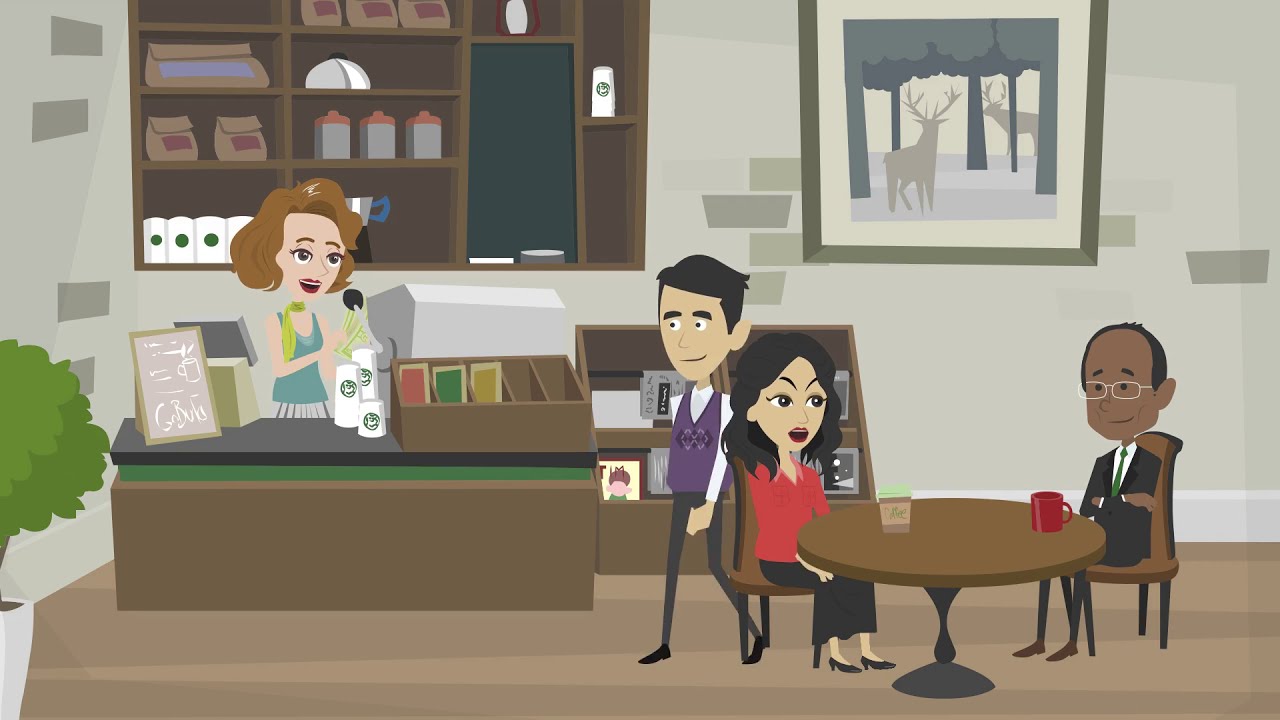
In American Sign Language (ASL), communication extends far beyond just the hands. Non-manual markers (NMMs) and body language are integral components that add layers of meaning, emotion, and grammatical information to signed conversations. Effectively utilizing these elements is crucial for natural and comprehensible ASL, especially in a dynamic environment like a coffee shop.Facial expressions are perhaps the most prominent NMMs in ASL.
They are not merely decorative but serve as grammatical markers and convey the emotional tone of the message. For instance, raised eyebrows often indicate a question, while a furrowed brow can signal confusion or a negative response. The mouth can also be used to express intensity, size, or shape, and specific mouth morphemes are associated with different verb types and adverbs.
A genuine smile can indicate friendliness and politeness, while a more serious expression might be used for conveying factual information or a request.
Facial Expressions for Tone and Meaning
Facial expressions in ASL are vital for conveying the nuanced tone and precise meaning of a signed utterance. They can transform a neutral statement into a question, express varying degrees of certainty, or imbue a sentence with emotional context. For example, a slight smile and relaxed facial muscles when ordering coffee convey politeness and approachability, making the interaction more pleasant for both the customer and the barista.
Conversely, a worried or rushed expression might signal that the customer is in a hurry or has a complex order.
Head Nods, Shakes, and Eyebrows
Head movements and eyebrow configurations are critical for grammatical functions and conversational flow in ASL. Head nods typically function as affirmations or confirmations, similar to “yes” in spoken English. Head shakes serve as negations, analogous to “no.” Eyebrows play a significant role in forming questions. For yes/no questions, eyebrows are usually raised during the signing of the question. For wh-questions (who, what, where, when, why, how), eyebrows are typically lowered or furrowed.
In a coffee shop setting, a quick head nod after the barista repeats your order confirms accuracy, while raised eyebrows during a request for clarification indicate you are seeking more information.
Body Posture in ASL Communication
Body posture significantly enhances ASL communication by providing context and reinforcing the message. An upright and open posture conveys confidence and engagement, which is welcoming in any social interaction, including ordering coffee. Leaning slightly forward can indicate attentiveness and interest, showing you are actively participating in the conversation. Conversely, a slumped posture might suggest disinterest or fatigue. Maintaining appropriate personal space and a relaxed, natural stance is key to effective and comfortable communication.
Visual Cues for Politeness and Emphasis
ASL utilizes specific visual cues to convey politeness and add emphasis to statements. Politeness is often expressed through gentle facial expressions, a slight smile, and smooth, deliberate signing. For instance, when asking for a pastry, a soft expression and a clear, unhurried sign for “pastry” with a slight nod can convey politeness. Emphasis can be achieved through a variety of means, including intensifying facial expressions, slightly larger signing space, and a more pronounced movement of the signs.
For example, if you want to strongly emphasize that you need your coffee “hot,” you might use a more intense facial expression and a more vigorous signing of “HOT.”
Expanding Your ASL Coffee Shop Vocabulary
To truly enhance your coffee shop interactions in ASL, it’s beneficial to expand your vocabulary beyond the basics. This section will introduce you to signs for a wider range of beverages and food items, as well as practical phrases for transactions and inquiries. Mastering these additions will make your ordering and communication smoother and more comprehensive.
Additional Beverages and Food Items
Familiarizing yourself with signs for various popular coffee shop offerings will greatly improve your ability to order and understand what’s available. Here are some common items you might encounter:
- Tea: The sign for tea typically involves forming a ‘T’ handshape with your dominant hand and bringing it to your mouth as if sipping from a cup.
- Hot Chocolate: This sign often combines the sign for “hot” (wiggling fingers of a flat hand near the mouth) with the sign for “chocolate” (often a circular motion with the index finger on the chest, representing a cocoa bean).
- Juice: The sign for juice usually involves the ‘J’ handshape moving downwards in a pouring motion, mimicking pouring juice into a glass.
- Muffin: The sign for muffin can be represented by forming a rounded shape with your hands, suggesting the dome of a muffin, often followed by a gesture of eating.
- Croissant: This sign often involves a curved handshape that mimics the crescent shape of a croissant, sometimes with a motion of spreading butter.
- Sandwich: The sign for sandwich is commonly made by bringing two flat hands together, representing the layers of bread and fillings.
Requesting Services and Information
Beyond ordering, you might need to request specific services or ask for information. Here are signs for common requests:
- Receipt: The sign for receipt can be made by forming a flat hand and then moving a flat index finger across it, as if writing on a slip of paper.
- Wi-Fi: The sign for Wi-Fi often involves forming a ‘W’ handshape and then making a circular motion in the air, representing the wireless signal.
Essential ASL Phrases for Coffee Shop Visits
To help you navigate common scenarios, here is a table of essential ASL phrases. Remember that the facial expressions and body language accompanying these signs are crucial for conveying politeness and clarity.
| English Phrase | ASL Sign Description |
|---|---|
| Hello | Wave your dominant hand with an open palm, moving it slightly from side to side. Maintain eye contact and a friendly expression. |
| Coffee | Form a fist with your dominant hand, then bring your thumb and index finger together as if holding a coffee cup handle. Bring this to your mouth and mime sipping. |
| Thank you | Touch your dominant hand to your chin, then move it forward and away from you towards the person you are thanking. A slight nod and smile are customary. |
| Water | Form a ‘W’ handshape with your dominant hand and bring it to your mouth, as if drinking from a glass. |
| Tea | Form a ‘T’ handshape with your dominant hand and bring it to your mouth, as if sipping from a cup. |
| Hot | Form a flat hand, palm facing you, and wiggle your fingers while moving the hand away from your mouth, indicating heat. |
| Cold | Form a fist with your dominant hand and shiver slightly, or bring your cupped hand to your mouth and blow on it as if it’s cold. |
| Please | Place your dominant hand flat on your chest and move it in a circular motion. |
| Yes | Form a fist with your dominant hand and nod your hand up and down. |
| No | Form an open hand with your dominant hand, palm facing forward, and shake it from side to side. |
| I want | Point your index fingers forward and bring them together in front of your chest, then move them forward slightly. |
| For here | Form a flat hand, palm facing up, and make a circular motion in front of you. |
| To go | Form a fist with your dominant hand and move it forward in a walking motion. |
| How much? | Form an open hand, palm facing up, and raise your eyebrows, looking questioning. Then, move your hands as if counting money. |
| Can I have…? | Form an open hand, palm facing up, and move it forward towards the person, with a questioning expression. |
| Delicious | Touch your index finger to your chin, then move it forward with a pleased expression. |
Closure
In conclusion, mastering basic ASL for coffee shop interactions opens up a world of accessible communication. By incorporating the greetings, ordering techniques, conversational phrases, and essential vocabulary discussed, you can confidently engage with baristas and fellow patrons. This skill not only enhances your coffee shop experience but also fosters a more inclusive environment.
We encourage you to practice these signs and integrate them into your routine. Remember that consistent use and a willingness to communicate are key to building fluency and making meaningful connections. Enjoy your next coffee shop visit with newfound ASL confidence!