Embark on a fascinating journey into the world of American Sign Language introductions with our comprehensive guide. This exploration will illuminate the subtle yet powerful ways ASL conveys social cues, ensuring your introductions are both clear and culturally sensitive. We’ll delve into the visual-gestural nature of ASL, emphasizing the crucial roles of facial expressions and body language in establishing connections.
Understanding the nuances of ASL introductions is key to fostering positive interactions. This guide provides a structured approach, covering essential signs, step-by-step procedures, and the art of adapting your communication to various social contexts. By mastering these elements, you’ll be well-equipped to confidently and gracefully introduce friends in ASL, building bridges and strengthening relationships.
Understanding the Core Concept of Introducing in ASL

Introducing someone in American Sign Language (ASL) is a nuanced and visually rich process that goes beyond simply stating names. It’s about establishing a connection and conveying social appropriateness through a combination of manual signs, facial expressions, and body language. The goal is to facilitate a comfortable and respectful interaction between individuals who may not know each other.The fundamental nature of ASL introductions lies in their visual-gestural modality.
Unlike spoken languages that rely on auditory cues, ASL uses the hands, face, and body to communicate meaning. This means that every element of the introduction, from the signs themselves to the subtle shifts in expression, carries significant weight in conveying information and social intent. Facial expressions are paramount, serving to indicate tone, emotion, and even grammatical information, while body language helps to establish proximity, orientation, and the overall dynamic of the introduction.
Typical Sequence of Actions in ASL Introductions
When introducing two people in ASL, there’s a generally accepted flow of actions that ensures clarity and politeness. This sequence helps to systematically convey the necessary information and set a positive tone for the interaction.The typical sequence involves several key components, executed in a fluid and connected manner:
- Getting Attention: Before any introduction can begin, it’s important to gain the attention of both individuals. This can be done by gently tapping someone on the shoulder, waving in their peripheral vision, or making eye contact and nodding.
- Indicating the Purpose: Once attention is secured, the introducer will typically use a sign or a gesture to indicate that an introduction is about to take place. This might involve pointing to oneself, then to the person being introduced, and then to the person they are introducing them to, often accompanied by a questioning facial expression.
- Introducing the First Person: The introducer will then introduce the first person, usually by signing their name (if known) or providing a descriptive classifier. This is often followed by a brief, positive statement about the person.
- Introducing the Second Person: The introducer then turns their attention to introduce the second person in a similar fashion.
- Facilitating Interaction: After both individuals have been introduced, the introducer may offer a brief comment or suggestion to encourage further conversation, such as signing “YOU-TWO TALK” or “NICE MEET.”
The Importance of Facial Expressions and Body Language
In ASL introductions, facial expressions and body language are not mere accessories; they are integral components that convey crucial social cues and add layers of meaning to the manual signs. The absence of vocal intonation in ASL makes these visual elements indispensable for effective communication and for establishing rapport.Facial expressions play a vital role in conveying the tone and intent of the introduction.
For instance:
- A warm smile and direct eye contact signal friendliness and openness.
- A slightly raised eyebrow might indicate a gentle inquiry or a polite request.
- A neutral or polite expression is generally used when introducing individuals who are not well-acquainted.
Body language further enhances the introduction by establishing the relationship between the individuals and the introducer:
- Orientation: The introducer will often orient their body towards both individuals, ensuring they can see each other clearly and feel included.
- Proximity: The physical space maintained between individuals can subtly communicate the level of familiarity or formality.
- Gestures: Hand gestures beyond the formal signs, such as a welcoming nod or a slight bow, can add politeness and warmth.
A key phrase often conveyed through a combination of signs and expression is the sentiment of meeting someone for the first time. This can be signed as “NICE MEET YOU” or “GOOD MEET YOU,” with the facial expression reinforcing the sincerity of the sentiment. The speed and fluidity of the signs, combined with the expressiveness of the face, collectively create a welcoming and comfortable environment for the individuals being introduced.
Essential ASL Signs for Introductions

To effectively introduce yourself and others in American Sign Language, a foundational vocabulary of signs is crucial. These signs act as the building blocks for clear and polite communication. Mastering these core elements will enable you to navigate introductory situations with confidence and grace.The following signs are fundamental to ASL introductions. They allow you to express basic information about yourself and the people you are introducing.
Understanding the nuances of each sign, particularly “FRIEND,” can further enhance the clarity and personal touch of your introductions.
Fundamental ASL Signs for Introductions
Here is a list of essential ASL signs commonly used when meeting new people and making introductions. These signs are direct and convey core information efficiently.
- MY: This sign is made by placing your open palm flat against your chest.
- NAME: Form an “H” handshape with both hands. Tap the middle finger of one hand twice on the palm of the other hand.
- YOU: Point your index finger directly at the person you are addressing.
- ME: Point your index finger towards yourself, usually at your chest.
- FRIEND: This sign involves interlocking your index fingers, with your index fingers pointing upwards.
- MEET: This sign is made by bringing your index fingers together, with both index fingers pointing upwards and palms facing each other, as if two people are coming together.
- HELLO: This is a common greeting sign. Form a “B” handshape with your dominant hand and bring it from your forehead outwards, similar to a salute.
Fingerspelling a Name in ASL
Fingerspelling is the process of spelling out words letter by letter using ASL handshapes. When introducing someone, clearly and legibly fingerspelling their name is vital for accurate recognition. This requires practice to ensure each letter is distinct and the movement is smooth.To fingerspell a name, hold your hand up with your palm facing the person you are communicating with. Move your hand slightly from side to side as you form each letter of the name.
Maintain a consistent pace and clear handshapes. Avoid rushing, as this can make the spelling difficult to follow. Pay attention to the shape of each letter and the transition between them.
Variations of the Sign “FRIEND”
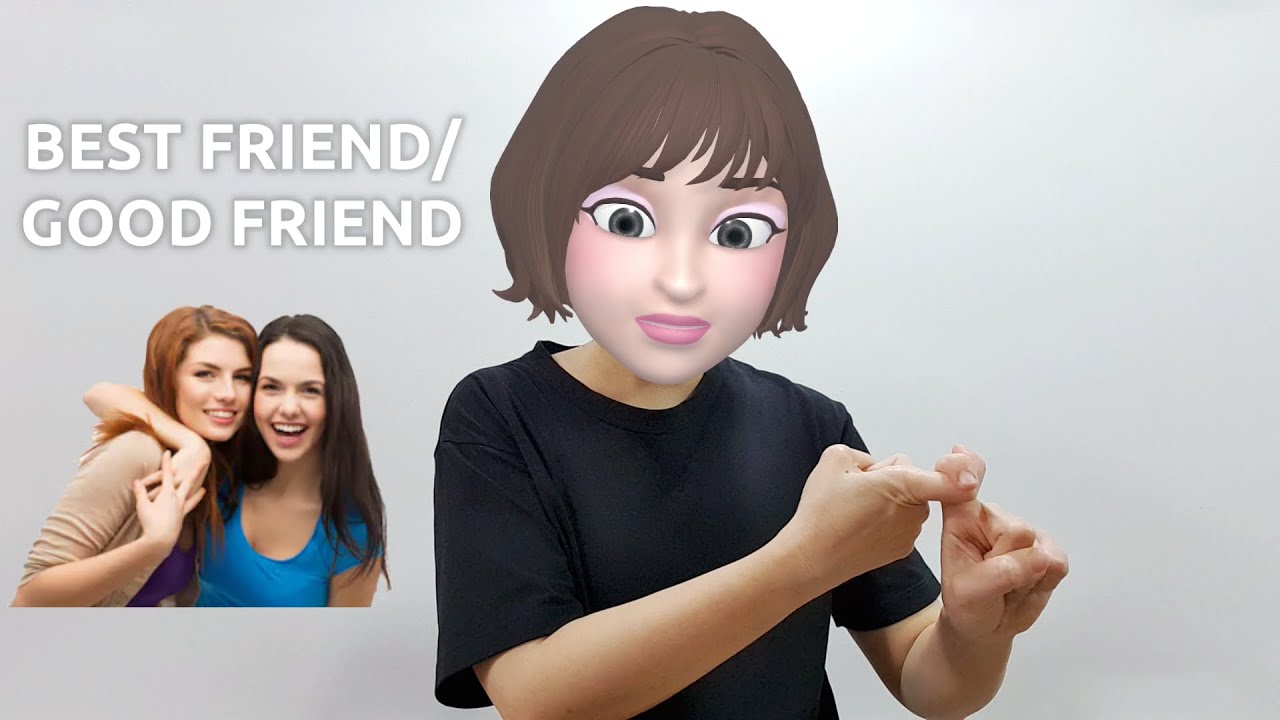
The sign for “FRIEND” can be adapted to reflect the depth and nature of a relationship. While the basic sign involves interlocking index fingers, subtle modifications can convey different levels of closeness.
- General Friend: The standard sign, as described above, is used for acquaintances or friends in general.
- Close Friend: For a closer friend, you might repeat the interlocking motion of the index fingers, or make the sign with a slightly more enthusiastic or intimate movement. Some individuals may also use a slightly more fluid or softer execution of the sign.
- Best Friend: To indicate a “best friend,” you might sign “FRIEND” twice, or emphasize the sign with a more pronounced and affirming movement. Another variation is to sign “FRIEND” and then follow it with a sign indicating strong connection or closeness.
Common Introductory Phrases and ASL Equivalents
Translating common English introductory phrases into ASL requires understanding the grammatical structure and cultural norms of the Deaf community. The following table provides common phrases and their direct ASL interpretations.
| English Phrase | ASL Equivalent (Description) |
|---|---|
| Hello, my name is [Name]. | HELLO MY NAME [fingerspell NAME]. |
| This is my friend, [Friend’s Name]. | THIS MY FRIEND [fingerspell FRIEND’S NAME]. |
| Nice to meet you. | NICE MEET YOU. (This is often signed as PLEASANT MEET YOU). |
| I am [Your Name]. | I [fingerspell YOUR NAME]. |
| And you are? | YOU? (Often signed with a questioning facial expression and head tilt). |
The sign “THIS” is typically made by forming a “1” handshape (index finger extended) and moving it from your mouth outwards. “PLEASANT” is signed by forming a flat hand and brushing it across your chest in a smooth, upward motion. The context and facial expressions are crucial in conveying the full meaning of these introductory phrases.
The Process of Introducing One Person to Another
Successfully introducing two people in American Sign Language (ASL) involves a clear, sequential process that ensures both individuals understand who the other is and their connection to you. This section will guide you through the essential steps, focusing on the order of signing and facilitating a comfortable exchange.The core of an ASL introduction relies on clarity and directness. You act as the bridge, connecting two individuals.
The process is designed to be efficient, allowing for natural conversation to follow.
Step-by-Step Introduction Procedure
Introducing Person A to Person B follows a logical progression. This procedure ensures that both individuals receive the necessary information to begin their interaction.
- Begin by signing your own name. This establishes your presence and identity in the introduction.
- Next, sign the name of the first person you are introducing (Person A).
- Indicate your relationship to Person A (e.g., “friend,” “colleague”).
- Then, sign the name of the second person you are introducing (Person B).
- Indicate your relationship to Person B.
- Finally, facilitate the exchange of names between Person A and Person B.
Signing Order for Names and Relationships
The order in which you present the names and relationships is crucial for a smooth introduction. Following this sequence ensures that the information is absorbed effectively by both parties.You will typically sign your name first, followed by the name of the person you are introducing. After stating their name, you clarify your connection to them. This pattern is then repeated for the second person.
My Name – Person A Name – Relationship to A – Person B Name – Relationship to B
For example, if you are introducing your friend Sarah to your colleague John, you would sign:YOUR-NAME – SARAH – FRIEND – JOHN – COLLEAGUE.
Facilitating Name Exchange
Once the initial introductions are made, it’s important to encourage the individuals to exchange their names directly. This promotes engagement and allows them to remember each other’s identities.After you have signed both names and your relationships, you can prompt them to sign their names to each other. This can be done with a simple questioning gesture or by signing “YOUR TURN” or “YOUR NAME?” directed towards each person.
You can also nod towards one person and then the other, indicating it’s their turn to sign their name.
Ensuring Smooth Transitions and Engagement
A successful introduction goes beyond just signing names; it’s about fostering a comfortable environment for further interaction. Techniques that encourage engagement can significantly improve the experience.
- Visual Cues: Use eye contact and head nods to direct attention between the two individuals as you sign their names.
- Verbal Prompts (if applicable): If you are also speaking, you can verbally prompt them to sign their names to each other.
- Contextual Information: Briefly mention a shared interest or commonality between the two people to give them an immediate topic of conversation. For example, after introducing Sarah (your friend) and John (your colleague), you might sign “SARAH LIKE HIKING. JOHN ALSO LIKE HIKING.”
- Gentle Guidance: If one person seems hesitant or unsure, offer a subtle cue or sign to help them initiate their turn.
- Positive Reinforcement: A smile and a nod after they have exchanged names can convey approval and encourage continued conversation.
Incorporating Context and Relationship Nuances

Successfully introducing individuals in ASL goes beyond simply stating names; it involves conveying the nature of your relationships with each person and respecting the social context. This nuanced approach ensures that the introduction is not only clear but also appropriate and considerate. By incorporating specific signs and non-manual markers, you can effectively communicate the depth of your connections and adapt your introduction to various settings, from casual get-togethers to formal professional events.Understanding these subtleties allows for more meaningful and comfortable interactions.
It demonstrates social awareness and linguistic skill within the Deaf community, fostering smoother transitions and stronger connections between the individuals being introduced.
Indicating Relationship Depth
The way you relate to each person you are introducing can be subtly communicated through ASL. This helps the individuals understand the basis of your connection to them and can guide their subsequent interactions.Here are common ways to indicate the nature of your relationship:
- Close Friend: Signs like FRIEND with a repeated, emphatic movement, or a warm, sustained facial expression, often accompanied by a gesture towards yourself and then the friend, can signify a deep bond. You might also use a sign for FAMILY if the friendship is that close.
- Acquaintance: A more neutral sign for FRIEND, perhaps with a single, less emphatic movement, and a more standard facial expression, indicates a friendly but less intimate connection.
- Colleague/Professional Contact: The sign WORK followed by FRIEND, or specific signs related to the professional field (e.g., BUSINESS, SCHOOL), combined with a professional demeanor, clarifies this type of relationship.
- Family Member: Specific signs for MOTHER, FATHER, SISTER, BROTHER, etc., are used. If introducing a spouse, the sign WIFE or HUSBAND is appropriate.
Conveying Politeness and Respect
Non-manual markers (NMMs) are crucial in ASL for conveying tone, emotion, and social cues, including politeness and respect.Consider these elements:
- Facial Expressions: A gentle smile, raised eyebrows (for a polite inquiry or acknowledgement), and direct but not overly intense eye contact are key. A slight nod can also convey agreement or acknowledgement.
- Body Language: Maintaining an open posture, turning slightly towards both individuals, and a relaxed but attentive stance demonstrate respect.
- Specific Signs: While not always a direct “please” or “thank you” in the same way as English, signs like NICE-MEET-YOU, GOOD, or PLEASE (often signed with a sweeping hand motion over the chest) can be incorporated after the names are exchanged to express positive sentiment. The sign THANK-YOU can be used if the introduction leads to a helpful interaction.
Adapting Introductions to Formality
The setting and the individuals involved dictate the level of formality in an ASL introduction. Adjusting your signs, NMMs, and overall approach ensures appropriateness.The key aspects of adaptation include:
- Formal Settings (e.g., Professional Conferences, Business Meetings):
- Sign Choice: Use clear, precise signs for names and professions. The sign for FRIEND might be used more sparingly or in a more reserved manner.
- NMMs: Maintain a more serious and professional facial expression. Avoid overly casual gestures or expressions. A firm handshake (if culturally appropriate and comfortable for all parties) can precede or follow the signing.
- Pacing: Speak or sign at a measured pace, allowing for clear comprehension.
- Semi-Formal Settings (e.g., Departmental Gatherings, Workshops):
- Sign Choice: A balance between clarity and warmth. The sign for FRIEND might be used more readily than in a strictly formal setting.
- NMMs: A pleasant, approachable expression is suitable. Eye contact should be maintained warmly.
- Pacing: Slightly more relaxed than a formal setting, but still clear and deliberate.
- Casual Settings (e.g., Social Gatherings, Parties):
- Sign Choice: More expressive and fluid signs are appropriate. Signs for FRIEND can be more animated.
- NMMs: A wide range of expressions, including laughter and more energetic gestures, are welcome.
- Pacing: Can be faster and more spontaneous, reflecting the relaxed atmosphere.
Introduction Scenarios
To illustrate how these principles are applied, consider the following scenarios:
Scenario 1: Casual Gathering (e.g., a friend’s birthday party)
Imagine you are at a party and want to introduce your close friend, Alex, to your acquaintance, Ben.
- Your Action: You approach Alex and Ben, who are standing near each other. You make eye contact with Alex and Ben, smiling warmly.
- Your Signing:
- You sign ALEX (your established sign for Alex), pointing to Alex, and then sign FRIEND with an emphatic, repeated movement, looking at Ben.
- Next, you sign BEN (your established sign for Ben), pointing to Ben, and sign FRIEND with a single, less emphatic movement, looking at Alex.
- You might add a sign like “TOGETHER” or “MEET” to facilitate their interaction.
- Your facial expression is relaxed and happy, reflecting the party atmosphere.
- Outcome: Alex and Ben understand that Alex is a close friend of yours, while Ben is someone you know more casually. They can then begin their own conversation, perhaps initiated by Alex asking Ben how he knows you.
Scenario 2: Professional Event (e.g., a networking reception)
Suppose you are at a professional conference and want to introduce your colleague, Sarah, to a potential client, Mr. Chen.
- Your Action: You see Mr. Chen and approach him. You then spot Sarah across the room and signal for her to join you.
- Your Signing:
- You sign MR. CHEN (using the established sign or spelling if no established sign exists), with a polite, respectful expression and a slight nod. You then sign COLLEAGUE or WORK-MATE, looking towards Sarah.
- You then sign SARAH (your established sign for Sarah), pointing to Sarah, and perhaps add the sign BUSINESS or a sign related to your shared profession, indicating your professional relationship.
- You would then sign NICE-MEET-YOU to Mr. Chen.
- Your facial expression is professional and composed, and your body language is open and attentive to both individuals.
- Outcome: Mr. Chen understands that Sarah is a professional associate of yours in the same field, and that you are introducing her in a professional capacity. This sets a formal and respectful tone for their interaction.
Visual Representation of ASL Introductions
The visual aspect of ASL introductions is crucial, as it goes beyond simple signs to convey warmth, openness, and clarity. Understanding the interplay of handshapes, palm orientations, and movement, along with the strategic placement of signs and expressive facial cues, paints a complete picture of a successful introduction.This section delves into the visual elements that make ASL introductions effective and engaging.
We will explore how the physical execution of signs, their positioning, and the accompanying non-manual markers contribute to the overall message and foster positive connections between individuals.
Initial Moments of an ASL Introduction
The initial moments of an ASL introduction are characterized by deliberate and clear visual communication. The focus is on presenting oneself and the person being introduced in a welcoming and easily understood manner.The handshapes used are typically standard and open, signaling approachability. For instance, the handshape for “MY” or “NAME” often involves an open palm or a relaxed fist. Palm orientations are generally directed towards the person being addressed or the person being introduced, fostering a sense of direct engagement.
The movement of signs is smooth and intentional, avoiding ambiguity. For example, the sign for “FRIEND” involves a gentle interlocking of index fingers, a movement that is both clear and symbolic of connection.
Placement of Signs in Relation to the Signer and the Person Being Introduced
The spatial arrangement of signs in ASL is a fundamental aspect of its grammar and a key component of introductions. The placement of signs helps to establish the referents and clarify who is being discussed or introduced.When introducing someone, the signer typically uses their signing space to represent the individuals involved. The person being introduced is often placed in a specific location within the signing space, and subsequent signs referring to them are directed towards that location.
For example, if you are introducing your friend who is standing to your right, you might establish their “space” to your right and then direct signs like “SHE” or “HE” towards that area. Similarly, signs referring to yourself are made in your own signing space, usually in front of your body. This spatial mapping ensures that the listener can easily track who is who throughout the introduction.
Sequence of Visual Descriptions for a Simple Introduction
To illustrate the visual flow of a basic ASL introduction, let’s break down the sequence for “My name is [Your Name], this is my friend [Friend’s Name].”The process begins with the signer.
- Signer’s Action: The signer turns slightly towards the person they are introducing their friend to.
- Sign: MY NAME
- Handshape: Flat hand (open palm).
- Palm Orientation: Palm facing inward, towards the signer’s chest.
- Movement: The flat hand touches the chest twice, near the collarbone area.
- Sign: [Your Name]
- Handshape: For fingerspelling, the ASL alphabet handshapes are used.
- Palm Orientation: Palms typically face forward or slightly inward.
- Movement: Each letter of the name is clearly articulated.
- Transition: A brief pause or a slight head nod to indicate the completion of the first part of the introduction.
- Sign: THIS IS
- Handshape: Index finger extended, other fingers closed.
- Palm Orientation: Palm facing downward or slightly forward.
- Movement: The index finger points forward, indicating the person being introduced. This sign can also be a pointing gesture.
- Sign: MY FRIEND
- Handshape: Two index fingers hooked together.
- Palm Orientation: Palms facing each other or slightly inward.
- Movement: The hooked index fingers interlock and then move slightly apart and back together.
- Sign: [Friend’s Name]
- Handshape: Fingerspelling the friend’s name using ASL alphabet handshapes.
- Palm Orientation: Palms typically face forward or slightly inward.
- Movement: Each letter of the name is clearly articulated.
Descriptive Elements of Facial Expressions for Positive Initial Interactions
Facial expressions are an integral part of ASL grammar and are essential for conveying the emotional tone and sincerity of an introduction. In positive initial interactions, specific facial cues amplify the welcoming and friendly nature of the exchange.A genuine smile is paramount, often accompanied by raised eyebrows to indicate openness and engagement. The eyes should be bright and direct, making eye contact with both individuals being introduced.
A slight nod of the head can further reinforce the positive sentiment and signal agreement or acknowledgment. A relaxed and approachable facial demeanor, free from tension, communicates comfort and ease. These non-manual markers work in conjunction with the manual signs to create a holistic and welcoming introduction.
Facilitating Further Interaction
Once the initial introductions have been made, the next crucial step is to help the newly acquainted individuals connect and begin their own conversation. This involves providing them with tools and opportunities to build upon the introduction, ensuring a comfortable and engaging transition. The goal is to empower them to discover common ground and continue the interaction independently.Encouraging further conversation is about creating a bridge between the two individuals, allowing them to explore shared interests and build rapport.
This can be achieved through subtle cues and suggestions that prompt them to find commonalities. It’s about setting the stage for them to feel comfortable and motivated to talk to each other.
Suggesting Shared Interests and Activities
To foster a natural flow of conversation, it is helpful to subtly introduce potential topics of shared interest. This can be done by referencing information you know about both individuals or by making general observations that might spark discussion. The aim is to provide starting points that are likely to resonate with both parties.Here are some ASL signs and phrases that can be used to suggest shared interests or activities:
- SAME-SAME: This sign, performed with both index fingers pointing upwards and moving in small circles, can be used to indicate that two people have something in common. For example, after introducing two people who both enjoy hiking, you might sign “YOU HIKING SAME-SAME YOU?”
- LIKE: The sign for “LIKE” (tucking the thumb of a closed fist into the chest and pulling it out) is fundamental. You can use it to inquire about preferences, such as “YOU LIKE MOVIES?” or “YOU LIKE BOOKS?”.
- INTEREST: This sign, made by forming a “C” shape with one hand and tapping the thumb of the other hand on the index finger, can be used to ask about hobbies or passions. For instance, “WHAT YOUR INTEREST?”.
- DO: The sign for “DO” (both hands in fists, one tapping the other) is versatile. It can be used to ask about activities, like “YOU DO WHAT FOR FUN?”.
- TOGETHER: The sign “TOGETHER” (both hands in fists, thumbs up, moving them forward together) encourages shared activities. You might sign “MAYBE YOU TWO GO TOGETHER TO EVENT?”.
- SHARE: The sign “SHARE” (both hands flat, palms up, one sliding over the other) can be used to suggest common experiences or knowledge. For example, “YOU SHARE IDEAS ABOUT PROJECT?”.
Strategies for Smoothly Exiting an Introduction
Effectively exiting an introduction is as important as the introduction itself. The goal is to leave the two individuals with the opportunity to continue their conversation without feeling awkward or rushed. This involves signaling your departure in a way that naturally transitions the focus back to them.When you are ready to leave the two individuals to converse, consider the following strategies:
- Verbal and Non-Manual Cues: Combine a polite ASL sign for “GOODBYE” or “SEE YOU” with a friendly facial expression and a nod. You can also use a slight backward movement of your head or body to indicate you are moving on.
- Brief Positive Reinforcement: Before leaving, you can offer a brief, positive statement that encourages their interaction. For example, you might sign “YOU TWO TALK” with a smile, or “HOPE YOU ENJOY TALKING.”
- Reference Future Interaction: If appropriate, you can mention a future context where you might see them again, further solidifying that your departure is not a rejection of their interaction. For example, “I SEE YOU AT PARTY LATER.”
- Focus on Their Interaction: Once you’ve signaled your intent to leave, turn your attention slightly away from them, giving them space to engage with each other without feeling observed.
The art of exiting an introduction lies in creating space, not in creating an absence.
Signaling Understanding and Acknowledgement
It is vital for both newly introduced individuals to acknowledge and confirm that they have understood the introduction. This can be done through simple ASL signs and non-manual markers that convey comprehension and readiness to engage. This confirmation helps to solidify the connection and ensures that both parties feel recognized.Both individuals can signal their understanding and acknowledgement in the following ways:
- Nodding: A simple, clear nod of the head is a universal sign of understanding and agreement.
- “YES” Sign: The sign for “YES” (a closed fist with the thumb extended, tapping the chest) is a direct confirmation.
- “UNDERSTAND” Sign: The sign “UNDERSTAND” (index finger of one hand pointing up, tapping the forehead with the middle finger of the other hand) clearly indicates comprehension.
- Eye Contact: Maintaining eye contact with the person being introduced to, and briefly with the introducer, shows engagement and attentiveness.
- Smile: A genuine smile conveys warmth and openness to further interaction.
- “HELLO” or “NICE MEET YOU” Sign: After the introduction is complete, they can independently sign “HELLO” or “NICE MEET YOU” to the other person, initiating their personal interaction.
Last Point
In conclusion, mastering the art of introducing friends in ASL opens up a richer and more inclusive way of connecting. We’ve explored the foundational principles, essential vocabulary, and practical application of ASL introductions, highlighting the importance of visual cues and contextual adaptation. By integrating these insights, you can confidently navigate social situations, ensuring smooth transitions and fostering genuine engagement between individuals.