How to Navigate a Conversation with a Deaf Person sets the stage for this enthralling narrative, offering readers a glimpse into a story that is rich in detail and brimming with originality from the outset.
This comprehensive guide delves into the nuances of effective communication with deaf individuals, moving beyond common misconceptions to foster genuine understanding. We will explore the foundational principles of visual communication, essential etiquette, and practical strategies for initiating and sustaining meaningful interactions. From mastering basic sign language greetings to leveraging technology and building empathy, this content is designed to equip you with the knowledge and confidence to engage respectfully and inclusively.
Understanding Communication Fundamentals
Effective communication with deaf individuals relies on a foundation of understanding how information is exchanged visually and aurally, and recognizing that their communication methods are not inherently deficient but rather different. This section will explore the crucial role of visual cues, address common misunderstandings, Artikel essential etiquette, and provide foundational sign language expressions.The deaf community has developed rich and nuanced ways of communicating, often leveraging visual information to an exceptional degree.
Recognizing and respecting these methods is paramount to fostering inclusive and successful interactions.
The Importance of Visual Cues in Communication
Visual cues are the cornerstone of communication for many deaf and hard-of-hearing individuals. This includes not only sign language itself but also facial expressions, body language, and the surrounding environment. These elements provide context, convey emotion, and clarify meaning in ways that spoken language often relies on auditory cues for. For instance, a raised eyebrow or a specific head tilt in sign language can indicate a question, a concept that would be conveyed through intonation in spoken English.
Understanding that communication is a multi-modal experience, where visual information is as vital as auditory, is key to bridging communication gaps.
Common Misconceptions About Deaf Communication
Several prevalent misconceptions can hinder effective communication with deaf individuals. One common misunderstanding is that all deaf people can read lips fluently; in reality, lip-reading is a difficult skill that varies greatly in proficiency and is often supplemented by other cues. Another misconception is that sign language is universal, when in fact, there are many different sign languages used around the world, just as there are spoken languages.
Furthermore, some may mistakenly believe that deaf individuals have a limited capacity for understanding or expressing complex ideas, which is entirely untrue. These misunderstandings can lead to frustration and miscommunication, underscoring the need for accurate information.
Essential Etiquette for Interacting with Deaf Individuals
Adhering to certain etiquette principles ensures respectful and effective communication. Always get the deaf person’s attention before speaking, typically by a gentle tap on the shoulder or a wave in their peripheral vision. Maintain eye contact when communicating, as this is crucial for visual cues and shows you are engaged. Speak clearly and at a normal pace, avoiding exaggerated mouth movements or shouting, which can distort lip-reading.
If you are unsure if the deaf person understands, it is polite to ask for clarification or to rephrase your statement. Remember that patience and a willingness to adapt are vital.
Fundamental Sign Language Greetings and Farewells
Learning a few basic sign language greetings and farewells can significantly enhance your interaction and demonstrate respect. These signs are part of American Sign Language (ASL), one of the most widely used sign languages in North America.To introduce basic greetings and farewells, the following list provides common signs and their descriptions:
- Hello: A flat hand moves from the forehead outwards, as if saluting.
- Hi: A simple wave of the hand.
- How are you?: The index finger and thumb of both hands form a “C” shape, and the hands move from the chest outwards. This is often accompanied by a questioning facial expression.
- Good: Both hands are flat, palms facing upwards. The dominant hand starts at the chin and moves downwards, with the palm facing upwards.
- Bad: Similar to “Good,” but the dominant hand moves downwards with the palm facing downwards, often with a slight shake.
- Thank you: The dominant hand is flat, with the fingertips touching the chin, and then moves forward away from the body.
- Goodbye: A flat hand waves from side to side.
- See you later: The index finger of the dominant hand points to the eye, then moves forward and down.
Establishing Effective Communication Channels

Successfully initiating and maintaining a conversation with a Deaf person relies on establishing clear and respectful communication channels. This involves understanding how to get attention, choosing appropriate methods for exchanging information, and leveraging visual cues effectively. By employing these strategies, you can foster a more inclusive and productive interaction.Establishing effective communication is a dynamic process that requires flexibility and a willingness to adapt.
It’s about finding common ground and ensuring that both parties feel understood and respected. The following sections detail key strategies to achieve this.
Initiating a Conversation
Starting a conversation with a Deaf individual requires a thoughtful approach that prioritizes their awareness and comfort. The goal is to signal your intent to communicate without causing alarm or disruption. A gradual and respectful introduction is key.The process of initiating a conversation can be broken down into several distinct steps:
- Identify the Person: Ensure you have the correct individual’s attention.
- Gain Attention Respectfully: Use one of the methods described below to signal your presence.
- Establish Visual Contact: Once you have their attention, make eye contact.
- State Your Intent: Briefly indicate you wish to speak with them, perhaps with a simple nod or a gesture.
- Introduce Yourself (Optional but Recommended): If appropriate, state your name.
- Begin Communication: Proceed with your chosen communication method.
Gaining Attention Respectfully
Capturing a Deaf person’s attention requires methods that are non-intrusive and considerate. Unlike hearing individuals who can be alerted by sound, Deaf individuals rely on visual or tactile cues. It is crucial to avoid startling them, which can be disorienting and unpleasant.Various methods can be employed to gain attention respectfully:
- Gentle Tap on the Shoulder or Arm: This is a common and effective method. Ensure the tap is firm enough to be felt but not so hard as to be jarring.
- Waving in Peripheral Vision: If you are in their line of sight but they haven’t noticed you, a gentle wave within their peripheral vision can alert them.
- Flickering Lights: In a room with overhead lighting, a brief flicker of the lights can be a signal. This is particularly useful in noisy environments where other visual cues might be missed.
- Vibrations: If you are close enough and the surface is stable (e.g., a table), gently stomping your foot or tapping the surface can create vibrations that can be felt.
- Gesturing: A clear, deliberate gesture indicating you want to speak can be effective, especially if you are already in their visual field.
It is important to observe the individual’s reaction and be prepared to repeat the signal if necessary, always maintaining a polite and patient demeanor.
Writing and Typing as Communication Tools
When spoken language is not a viable option, writing and typing emerge as powerful and accessible tools for communication. These methods allow for precise expression and can be particularly helpful for conveying complex information or for individuals who are not fluent in sign language.The use of writing and typing offers several advantages:
- Clarity and Precision: Written or typed messages can be reviewed and edited, ensuring accuracy and reducing the potential for misinterpretation.
- Record Keeping: Written communication provides a tangible record of the conversation, which can be beneficial for future reference.
- Accessibility for All: These methods are accessible to a wide range of individuals, regardless of their sign language proficiency.
- Pacing Control: Both participants can take their time to formulate their thoughts and responses, allowing for a more thoughtful exchange.
Practical applications include using a notepad and pen, a whiteboard, or the text messaging or note-taking applications on a smartphone or tablet. When typing, it is helpful to use clear, concise sentences and to allow the Deaf person ample time to read and respond.
Lip-Reading and Its Limitations
Lip-reading, also known as speech-reading, is a skill that some Deaf individuals utilize to understand spoken language by observing the movements of a speaker’s lips, jaw, and tongue. While it can be a supplementary communication method, it is crucial to understand its inherent limitations.The effectiveness of lip-reading is influenced by several factors:
- Visibility of Mouth Movements: Many sounds look identical on the lips (e.g., “p,” “b,” and “m”).
- Speaker’s Clarity: The speaker’s enunciation, speed, and accent significantly impact readability.
- Facial Hair and Lighting: Beards, mustaches, or poor lighting can obscure lip movements.
- Environmental Factors: Background noise, distractions, and distance can hinder comprehension.
- Individual Skill: The proficiency of the lip-reader varies greatly.
Due to these limitations, relying solely on lip-reading is often insufficient for full comprehension. It is best used in conjunction with other communication strategies.
Utilizing Visual Aids and Gestures
Visual aids and gestures are indispensable tools for bridging communication gaps and enhancing understanding with Deaf individuals. They provide concrete representations of ideas, actions, and objects, making abstract concepts more tangible and accessible.A comprehensive guide to utilizing visual aids and gestures includes:
- Natural Gestures: Employing natural, universally understood gestures can convey meaning effectively. For example, pointing to an object, miming an action like eating or drinking, or using directional gestures.
- Facial Expressions: Exaggerated but clear facial expressions can convey emotions and nuances that words alone might not capture. A smile, a frown, or a look of confusion can significantly enhance understanding.
- Drawing: Simple sketches on paper or a digital screen can clarify locations, objects, or processes. For instance, drawing a map to a location or sketching a simple diagram of how something works.
- Objects and Props: Using actual objects or props related to the conversation can provide immediate context and understanding. If discussing a book, holding up the book is more effective than describing it.
- Pictures and Diagrams: Pre-existing images, photographs, or diagrams can be invaluable for explaining concepts, places, or people. For example, showing a picture of a specific building to indicate a meeting point.
- Demonstration: Physically demonstrating an action, such as how to operate a piece of equipment, is often the clearest way to convey instructions.
When using gestures, ensure they are clear, deliberate, and in line with the context of the conversation. Avoid overly complex or ambiguous movements.
Navigating Different Communication Scenarios
Effectively communicating with deaf individuals requires adaptability and a thoughtful approach to various interaction settings. Understanding the nuances of each scenario allows for more inclusive and successful exchanges. This section Artikels strategies for common communication situations.
One-on-One Conversations
Successful one-on-one communication hinges on creating a focused and comfortable environment for both participants. The goal is to ensure clear reception of information and a sense of mutual understanding.
- Visual Focus: Position yourself so your face is well-lit and clearly visible. Avoid standing with a bright light source behind you, which can obscure your facial expressions.
- Clear Speech and Pace: Speak at a natural pace, enunciating clearly without exaggerating or shouting. Shouting can distort lip movements and be uncomfortable.
- Gestures and Facial Expressions: Utilize natural gestures and expressive facial movements to supplement spoken language. These visual cues are integral to understanding.
- Confirmation and Clarification: Periodically check for understanding by asking open-ended questions rather than simple yes/no questions. Encourage the deaf individual to signal if they need clarification.
- Patience: Allow ample time for responses. Rushing the conversation can lead to misunderstandings and a feeling of being unheard.
Group Discussions
Group settings present unique challenges due to multiple speakers and a dynamic flow of conversation. Strategies to ensure participation and comprehension are crucial for inclusivity.
- Speaker Identification: Ensure it is clear who is speaking. This can be done by having each speaker introduce themselves or by establishing a system where the current speaker is visually indicated.
- Turn-Taking: Establish clear turn-taking signals. This could involve raising a hand, a specific gesture, or the facilitator calling on individuals.
- Summarization: The facilitator or a designated person can periodically summarize key points discussed to ensure everyone is on the same page.
- Visual Aids: Utilize whiteboards, flip charts, or digital displays to present information visually, which can benefit all participants, especially those who are deaf.
- Equal Access: Ensure that all participants have an opportunity to speak and be heard. Avoid conversations that become dominated by a few voices.
Managing Interruptions or Misunderstandings
Interruptions and misunderstandings are natural parts of any conversation, but they require careful management to maintain effective communication with deaf individuals.
- Acknowledge and Rephrase: If an interruption occurs, acknowledge it and then rephrase your statement or the misunderstood point. This shows you are attentive and committed to clarity.
- Request Repetition or Clarification: Do not hesitate to ask the deaf individual to repeat themselves or to clarify their meaning. Similarly, encourage them to do the same.
- Non-Verbal Cues: Pay close attention to the deaf person’s non-verbal cues, such as confused facial expressions or body language, which can signal a breakdown in understanding.
- Break Down Complex Information: If a topic is complex, break it down into smaller, more manageable parts. This makes it easier to follow and less prone to misunderstanding.
- Written Follow-up: For critical information, offer to follow up with a written summary via email or text to ensure accuracy.
Communicating in Noisy or Distracting Environments
Noisy or visually distracting environments can significantly impede communication. Adapting strategies is key to overcoming these challenges.
- Move to a Quieter Area: If possible, relocate to a space with less background noise and fewer visual distractions.
- Increase Visual Prominence: Ensure your face is well-lit and directly in their line of sight. Use larger gestures.
- Pre-Communication: Before engaging, briefly explain the communication method you will use and any limitations of the environment.
- Use Written Communication: In very loud environments, switching to text-based communication (e.g., phone apps, notepad) may be the most effective solution.
- Focus on One Speaker: In a group setting, try to isolate and focus on one speaker at a time. Politely ask others to wait their turn.
Handling Technical Difficulties with Communication Aids
Communication aids, whether technological or manual, can sometimes malfunction. Having a plan for these situations is essential.
- Backup Methods: Always have a backup communication method ready. This could be pen and paper, a different app, or a pre-arranged sign language interpreter.
- Troubleshooting: Remain calm and attempt basic troubleshooting steps. This might include checking battery levels, restarting devices, or ensuring good internet connectivity.
- Communicate the Issue: Clearly communicate to the deaf individual that there is a technical issue and what steps you are taking to resolve it.
- Adaptation: Be prepared to switch to a less ideal but functional method. For example, if a speech-to-text app is failing, revert to manual typing or even written notes.
- Focus on the Message: Remember that the goal is to convey information. If a specific aid is not working, prioritize finding any method that allows the message to get through.
Leveraging Technology and Resources

In today’s interconnected world, technology offers a powerful suite of tools and resources to bridge communication gaps and enhance interactions with deaf individuals. By embracing these advancements, we can foster more inclusive and effective communication environments.
Useful Apps and Tools for Deaf Communication
A variety of applications and digital tools are specifically designed to support and facilitate communication with deaf individuals. These can range from simple text-based messaging to more sophisticated visual communication platforms.
- Speech-to-Text Apps: These applications listen to spoken language and convert it into written text in real-time, allowing deaf individuals to read what is being said. Examples include Live Transcribe (Android) and Otter.ai.
- Text-to-Speech Apps: Conversely, these apps allow deaf individuals to type messages that are then spoken aloud, enabling them to participate in spoken conversations.
- Sign Language Recognition Apps: Emerging technologies are beginning to offer apps that can recognize sign language gestures and translate them into text or speech, and vice-versa. While still developing, these hold significant promise.
- Visual Communication Platforms: Apps like FaceTime, Skype, and Zoom are invaluable for video calls, which are crucial for sign language communication.
- Augmentative and Alternative Communication (AAC) Devices: For individuals with complex communication needs, AAC devices offer customized ways to express themselves, often through symbol-based systems or synthesized speech.
Video Relay Services (VRS)
Video Relay Services are a vital telecommunications service that enables deaf and hard-of-hearing individuals who use sign language to communicate with hearing individuals by telephone. The process involves a three-way call.
- How VRS Works: A deaf caller initiates a call through a VRS provider’s application or website. A sign language interpreter, watching the deaf caller via video, then relays the signed conversation into spoken words to the hearing party. The interpreter simultaneously relays the hearing party’s spoken words back into sign language for the deaf caller.
- Benefits of VRS: VRS offers independence and equity in communication, allowing deaf individuals to make and receive phone calls for personal, business, and emergency purposes without relying on a hearing intermediary. It ensures the nuances of sign language are accurately conveyed.
The Role of Interpreters and Effective Collaboration
Professional sign language interpreters are skilled facilitators of communication, ensuring that meaning, intent, and cultural context are accurately conveyed between deaf and hearing individuals. Working effectively with an interpreter enhances the overall communication experience.
- When to Use an Interpreter: Interpreters are essential for complex discussions, formal settings, medical appointments, educational environments, and any situation where clear and accurate communication is paramount.
- Working Effectively with an Interpreter:
- Speak directly to the deaf person, not to the interpreter. Maintain eye contact with the deaf individual.
- Speak at a natural pace and pause periodically to allow the interpreter time to interpret.
- Avoid speaking over the interpreter or interrupting them.
- Be prepared to repeat or rephrase if the deaf person indicates they did not understand.
- Inform the interpreter of any specialized terminology or context beforehand.
- Understand that interpreters are neutral parties and do not participate in the conversation.
Resources for Learning Basic Sign Language Vocabulary
Learning basic sign language can significantly enhance your ability to communicate with deaf individuals, fostering stronger connections and demonstrating respect. Numerous resources are available for beginners.
- Online Dictionaries and Learning Platforms: Websites like Signing Savvy, Hands On ASL, and Lifeprint.com offer extensive dictionaries of signs with videos and explanations. Many also provide structured lessons.
- Mobile Applications: Apps such as Marlee Signs and The ASL App offer interactive ways to learn vocabulary and grammar through visual aids and quizzes.
- Local Community Resources: Check with local deaf community centers, colleges, or organizations for introductory sign language classes or workshops.
- YouTube Channels: Many talented deaf creators and sign language instructors share free lessons and vocabulary tutorials on YouTube, covering a wide range of topics.
Learning even a few basic signs can make a profound difference in making someone feel seen and valued.
Enhancing Understanding and Empathy
Moving beyond the mechanics of communication, fostering genuine understanding and empathy is paramount to building strong relationships with deaf individuals. This involves cultivating an environment where both parties feel respected, heard, and valued. It’s about actively seeking to comprehend not just the words exchanged, but also the underlying emotions and perspectives.Empathy in communication with the deaf community is a bridge built on patience, attentiveness, and a willingness to learn.
It requires us to step outside our own communication preferences and actively adapt to ensure clarity and connection. This section will explore practical strategies to deepen this understanding and foster a more inclusive communication experience.
The Importance of Patience and Active Listening
Patience is a cornerstone of effective communication, especially when navigating potential communication barriers. It allows for a more relaxed and less pressured exchange, giving both individuals the time needed to express themselves fully and comprehend accurately. Rushing a conversation can lead to misunderstandings, frustration, and a breakdown in communication. Active listening, in this context, involves more than just hearing; it’s about observing body language, facial expressions, and any other cues that supplement or clarify the message.
It means fully concentrating, understanding, responding, and remembering what is being communicated.
“Patience is not the ability to wait, but the ability to keep a good attitude while waiting.”
When communicating with a deaf person, active listening might involve:
- Maintaining eye contact to show engagement.
- Nodding to indicate understanding or encourage continuation.
- Using visual cues like pointing or gesturing to reinforce meaning.
- Being mindful of your own body language to ensure it is open and welcoming.
- Allowing for pauses without interruption, as processing information can take longer.
Examples of Supportive and Inclusive Language
The language we use significantly impacts how supported and included individuals feel. Supportive and inclusive language aims to be respectful, affirming, and avoids any assumptions or stereotypes. It prioritizes the individual and their preferred mode of communication.When referring to the deaf community, it is generally preferred to use terms like “Deaf” (capitalized) when referring to cultural identity and community, and “deaf” (lowercase) for the audiological condition.
It is always best to ask an individual how they prefer to be identified.Examples of supportive language include:
- “How can I best communicate with you?” instead of assuming a method.
- “I’m happy to repeat that if you didn’t catch it” demonstrates a willingness to accommodate.
- “Please let me know if you need me to slow down or rephrase” offers a clear invitation for clarification.
- Using person-first language, such as “a person who is deaf,” unless the individual prefers identity-first language.
- Acknowledging and validating their communication efforts, such as “Thank you for your patience.”
Conversely, avoid phrases that are dismissive or patronizing, such as “Can you even understand me?” or “You’re so good at lip-reading for someone who’s deaf.”
Asking Clarifying Questions Without Causing Offense
Seeking clarification is a vital part of ensuring understanding, but it needs to be done thoughtfully to avoid making the other person feel inadequate or interrogated. The key is to frame questions in a way that expresses your desire to understand better, rather than implying they have communicated poorly.It is helpful to preface clarifying questions with phrases that demonstrate your commitment to accurate comprehension.
This shifts the focus from a potential communication failure to your proactive effort to ensure clarity.Effective ways to ask clarifying questions include:
- “Could you please repeat that, perhaps a little slower?” This directly addresses a pace issue.
- “Just to make sure I’ve understood correctly, are you saying [summarize your understanding]?” This allows them to confirm or correct your interpretation.
- “Could you show me what you mean?” This is particularly useful if gestures or visual aids can help.
- “I missed a little bit there, could you spell that word for me?” This is a direct request for specific information.
- “What was the last part again?” This is a simple request to repeat a section.
The tone of voice, facial expression, and body language accompanying these questions are as important as the words themselves. A genuine smile and an open posture will convey your positive intent.
Insights on Cultural Nuances within the Deaf Community
The Deaf community, like any cultural group, possesses its own unique set of values, traditions, and social norms. Understanding these nuances is crucial for respectful and effective interaction. These can vary significantly across different regions and even within sub-groups of the Deaf community.One significant aspect is the strong sense of community and shared identity among culturally Deaf individuals. This often manifests in a preference for sign language as a primary mode of communication and a deep appreciation for Deaf culture, which includes its own art, literature, and history.Key cultural nuances to be aware of include:
- Directness: Communication within the Deaf community can sometimes be more direct than in hearing cultures. This is not intended to be rude but is a facet of efficient communication.
- Visual Focus: There is a strong emphasis on visual information. This means paying attention to the environment, gestures, and expressions is highly valued.
- Turn-Taking: In sign language conversations, turn-taking is often visually cued and can differ from the auditory cues used in spoken language.
- Personal Space: While not universal, some individuals may have different perceptions of personal space. Observing their comfort level is important.
- The “Deaf Goodbye”: It is common for Deaf individuals to have longer goodbyes, involving more extended interactions and farewells, reflecting the value placed on social connection.
It is always advisable to approach interactions with an open mind and a willingness to learn, rather than making assumptions based on hearing cultural norms.
Scenario: A Successful Interaction
Imagine Sarah, a hearing individual, needs to discuss a project deadline with Mark, who is Deaf and uses American Sign Language (ASL). Sarah has some basic ASL knowledge and is aware of the importance of visual communication.Sarah approaches Mark, making sure to get his attention by a gentle tap on the shoulder. She smiles and signs, “Hello Mark. Can we talk about the project deadline?” Mark signs back, “Hello Sarah.
Yes, I have time.”Sarah then uses a combination of her ASL and gestures. She signs “Deadline,” then holds up three fingers and points to a calendar. She then signs “When?” Mark watches intently, his eyebrows raised slightly in concentration. He signs back, “Three days.”Sarah wants to confirm. She signs, “So, three days from today?” Mark nods enthusiastically and signs, “Yes.
Is that okay?” Sarah signs, “Yes, that is good. Thank you.” She then adds, “If I have questions, can I sign to you later?” Mark signs, “Yes. Or I can write.”This interaction is successful because:
- Sarah initiated contact respectfully and visually.
- Both individuals used their preferred communication methods.
- Sarah used clear, concise signs and gestures.
- She asked a clarifying question to confirm understanding.
- Mark was offered alternative communication methods (writing).
- The interaction was positive and affirmed their working relationship.
Final Conclusion
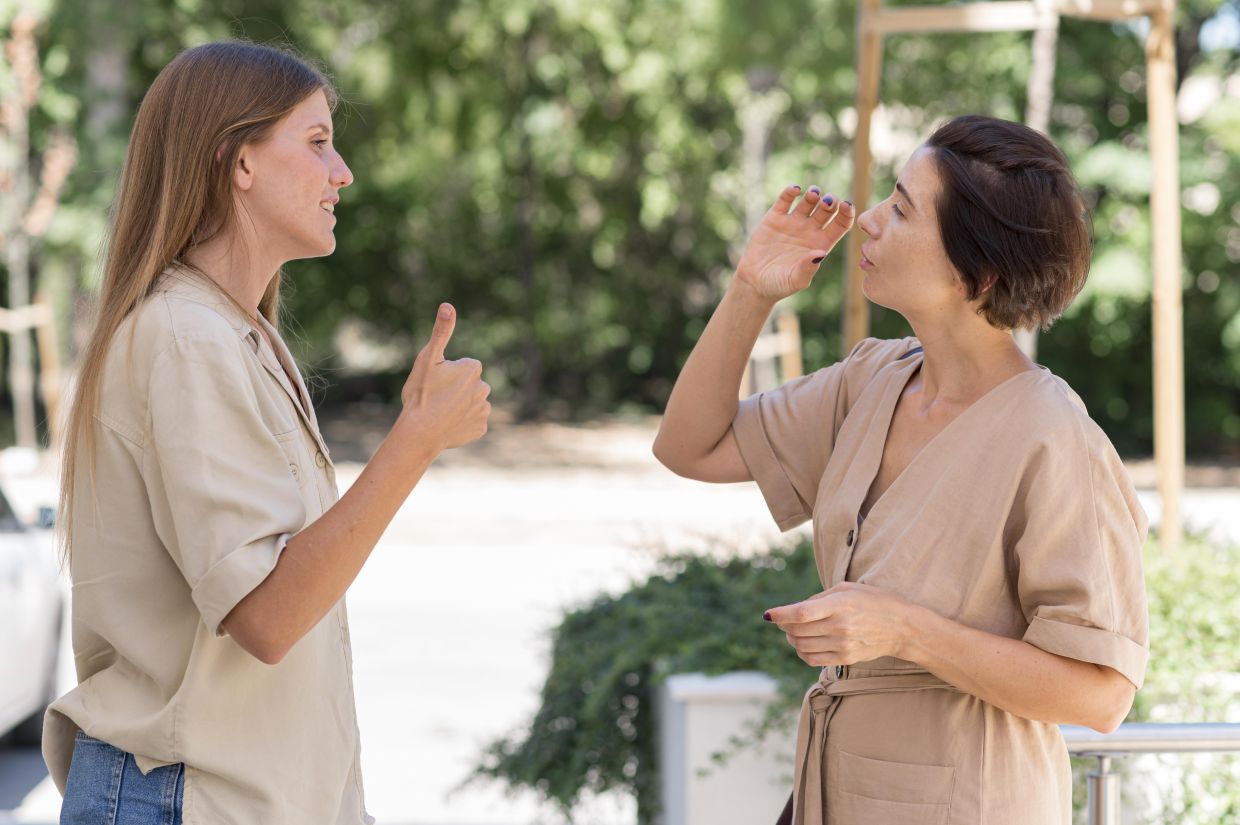
In conclusion, navigating conversations with deaf individuals is an enriching experience that deepens our understanding of communication and fosters stronger connections. By embracing patience, utilizing visual cues, and respecting diverse communication methods, we can build bridges of understanding and create more inclusive environments for everyone. This guide has provided a roadmap to empower you in these interactions, transforming potential challenges into opportunities for meaningful engagement and mutual respect.